
St. George and Washington County
Concrete coatings
Flake, solid color and grind-and-seal finishes over concrete, inside and out. Most of the job is the slab underneath, which is the part nobody quotes and the part that decides whether it lasts.
17 kinds of work below. Prices go on this page as each one is set, and never before. Read our Plain Terms
Garage floors
Garage floor coating
The bay emptied, the slab ground back, and a finish that is bonded to concrete rather than sitting on it.
Flake floor
Vinyl chips broadcast into a wet base coat and locked under a clear top coat. The common finish, and the one in most of the photographs here.
Solid color floor
One color, no chips. The plainest finish, and the one that shows every repair in the slab beneath it.
Metallic floor
A pigmented resin worked while wet so the color moves. No two are the same, which is the point and also the risk.
Grind and seal
The concrete itself is the finish. Ground back, then sealed. Nothing is added on top to fail.
What you are actually buying
Not a product. Nearly all of what decides whether a coated floor is still good in five years happens before any color goes down, and none of it is visible afterwards: how much of the slab came off, what the moisture read, and whether the cracks were repaired or painted over.
So we quote the preparation in detail and in writing, rather than quoting a finish and treating the grinding as something that happens on the day. If a quote you are comparing ours against does not mention a surface profile or a moisture test, those are not two prices for the same job.
One number, one quote, and it does not change after the grinder comes out.
What you get in writing
- The moisture reading, and which published test produced it.
- The surface profile the finish requires, as a number on the published scale.
- What happens to each crack, priced as its own line rather than absorbed.
- If we think your slab should not be coated, you hear that before you have paid for anything.
You keep all of it whether or not you hire us. Plain Terms covers who does the work, the license and insurance behind it, and the one number you call when something is wrong.
Outside the house
Driveway and apron coating
The slab that takes the sun, the tires and the blown sand. Exterior work is scheduled around weather, not around us.
Patio and porch coating
Resurfacing the slab you have, rather than breaking it out.
Pool deck coating
Textured on purpose. A deck has to stay walkable wet and bearable barefoot.
Walkways and steps
The awkward work: edges, risers, nosings and curves, most of it done by hand.
What is different about doing this in Washington County
The heat is a working condition, not a talking point
St. George recorded 98 days at or above 100°F in 2024, the most on record, and the all-time high is 117°F. July has now set the record two years running.
That is what the finished floor lives with. It is also a constraint on the work: resin systems have a published application temperature window and their working time shortens as the slab warms. A July install in an uncooled garage is a scheduling problem before it is anything else.
The sand is why the date moves
The Utah Geological Survey maps wind-blown sand as one of nine adverse construction conditions for the St. George and Hurricane area, and Washington County publishes it as its own hazard layer. Most counties do not map blowing sand at all. Utah’s Department of Environmental Quality notes that from spring through fall, high winds and dry ground combine into dust storms that “can lead to extremely high levels of particulate matter.”
Wet resin holds whatever lands in it, permanently. April is the windiest month here. So an exterior date is a forecast-dependent date, and anybody who books you one three weeks out without saying so is promising something they do not control.
The monsoon, and the calendar
Flooding is, in Special Study 127’s words, “the most widespread and damaging geologic hazard in southwestern Utah.” It arrives as short heavy cells after long dry spells — St. George has recorded a 78-day dry spell ending with monsoon onset. An exterior coating cannot go onto a wet slab and cannot cure through a storm.
At the other end of the year, the reliably non-freezing window here runs March 1 to November 21, and resin has a published minimum cure temperature. An exterior slab in January can sit under it.
The ground, and what it does to concrete
Gypsiferous soil and rock is another of those nine mapped conditions, and where sulfate is present in the ground it attacks concrete itself. Under the American Concrete Institute exposure classes, a soil sulfate test determines the mix a slab needs — class S1 at 0.10 to 0.20 per cent water-soluble sulfate, S2 at 0.20 to 2.00 per cent where sulfate-resistant cement is required, S3 above that. St. George culinary water itself runs to 451 parts per million sulfate, inside class S1 for water contact.
We do not test soil and we are not going to tell you your slab is failing. We will tell you whether your address sits in a mapped zone, show you the county’s own map, and say plainly that the condition of the concrete is a question that comes before the question of what to put on it.
Inside the house
Basement floor coating
A finished floor rather than a subfloor waiting for one. Moisture gets tested first, and that is not optional below grade.
Interior concrete floor
Laundry rooms, utility rooms, workshops and casitas. Anywhere the slab is the floor.
The other failure: water you cannot see
Most houses here are built on a slab, and a slab on grade is in permanent contact with the ground. Water vapor moves from the ground up through the concrete toward the room. A coating is a comparatively airtight film laid across the top of that. Where the vapor drive is strong enough, pressure builds underneath and the film blisters or releases.
Whether a vapor retarder was laid under your slab was decided the day the house was poured and cannot be changed now. An older house here may have none. That does not rule out a coated floor. It rules out guessing.
There are three published tests and they do not measure the same thing:
- ASTM F2170 reads the internal relative humidity from probes set in holes drilled to 40 per cent of the slab depth. It tells you what the slab will do over time, and it has been displacing the older method since 2002.
- ASTM F1869 calculates a moisture vapor emission rate from the weight a dish of calcium chloride gains under a sealed dome over three days. It reflects the surface, not the interior, and since 2010 the standard has disallowed it on lightweight concrete.
- ASTM D4263, the plastic sheet method, is the quick one — used, in the standard’s own words, “to indicate the presence of capillary moisture in concrete.” It shows surface conditions only.
You do not have to know any of that. You have to know it exists, that it produces a number, and that you can ask for the number in writing. We will run it and hand you the reading whether or not you hire us.
Commercial and industrial
Commercial floor coating
Retail, showroom and service floors, sequenced so the business stays open where it can.
Warehouse and shop floor
Large slabs, forklift traffic and a schedule that belongs to somebody else.
The slab underneath
Concrete slab assessment
Moisture tested to the published methods, the surface profile agreed, and you get the readings whether or not you hire us.
Concrete grinding and preparation
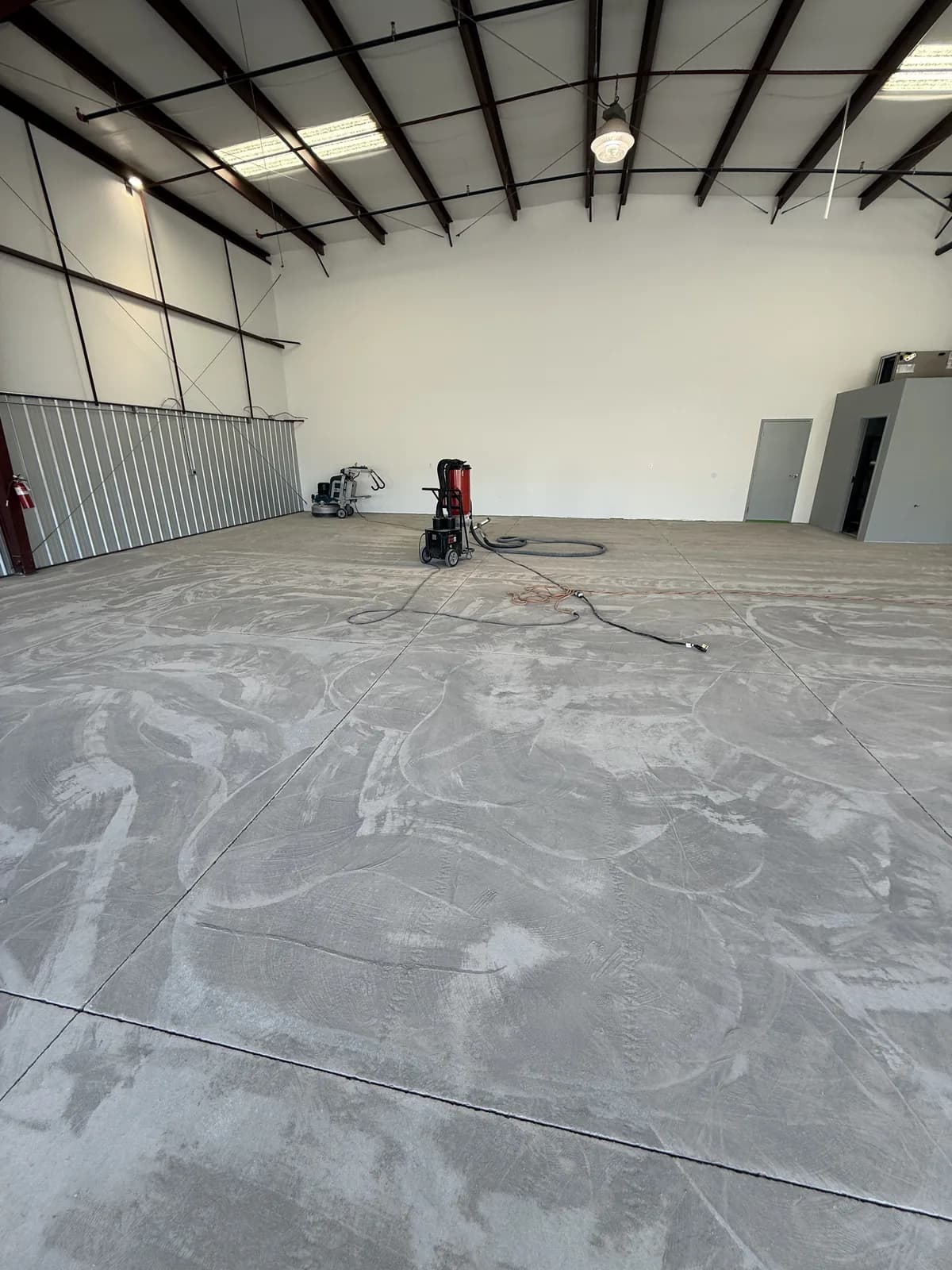
Diamond grinding to take the slab back past its surface film. It is most of the labor and all of the difference.
Failed coating removal and recoat
Taking off what is peeling, finding out why it did, and telling you before we quote putting anything back.
Concrete cleaning and sealing
Washing and sealing bare or stained concrete. Recurring work, not once.
Almost every failure is a preparation failure
Concrete finishes with a weak, fines-rich film on its surface called laitance. It is a normal product of how a slab is poured and floated, not a defect. It is also not something a coating can bond through. A finish rolled over laitance is bonded to the laitance, and the day the laitance lets go, the floor looks like the coating failed.
The requirement is published, and not by us. Sika’s surface preparation guide puts it this way: concrete substrates “must be mechanically prepared to remove cement laitance, existing coatings, curing compounds, and achieve a profile that is clean, dry, and free from dirt, grease, oil.” Diamond grinders, in the same guide’s words, “are used to create a surface profile, remove high spots on a concrete surface and remove coatings.” Shot blasting it calls “the industry standard for surface preparation of concrete.”
What grinding leaves behind has a number. The International Concrete Repair Institute publishes the scale in Guideline 310.2R-2013, running from CSP 1 — essentially unchanged concrete with the loose debris removed — through CSP 9 and beyond at exposed aggregate. Physical replica chips exist so a prepared slab can be held against the number and accepted or rejected. Most coating manufacturers now state the profile their product needs on its own data sheet.
That is why the useful question is not do you grind. It is what profile did you grind to, and how did you check it. Ask us. Ask whoever else is quoting you.
This work
What it looks like on the job.
Finished work, before-and-after pairs and the preparation in between. No caption names a town: these were not all shot in Washington County and we are not going to imply otherwise.
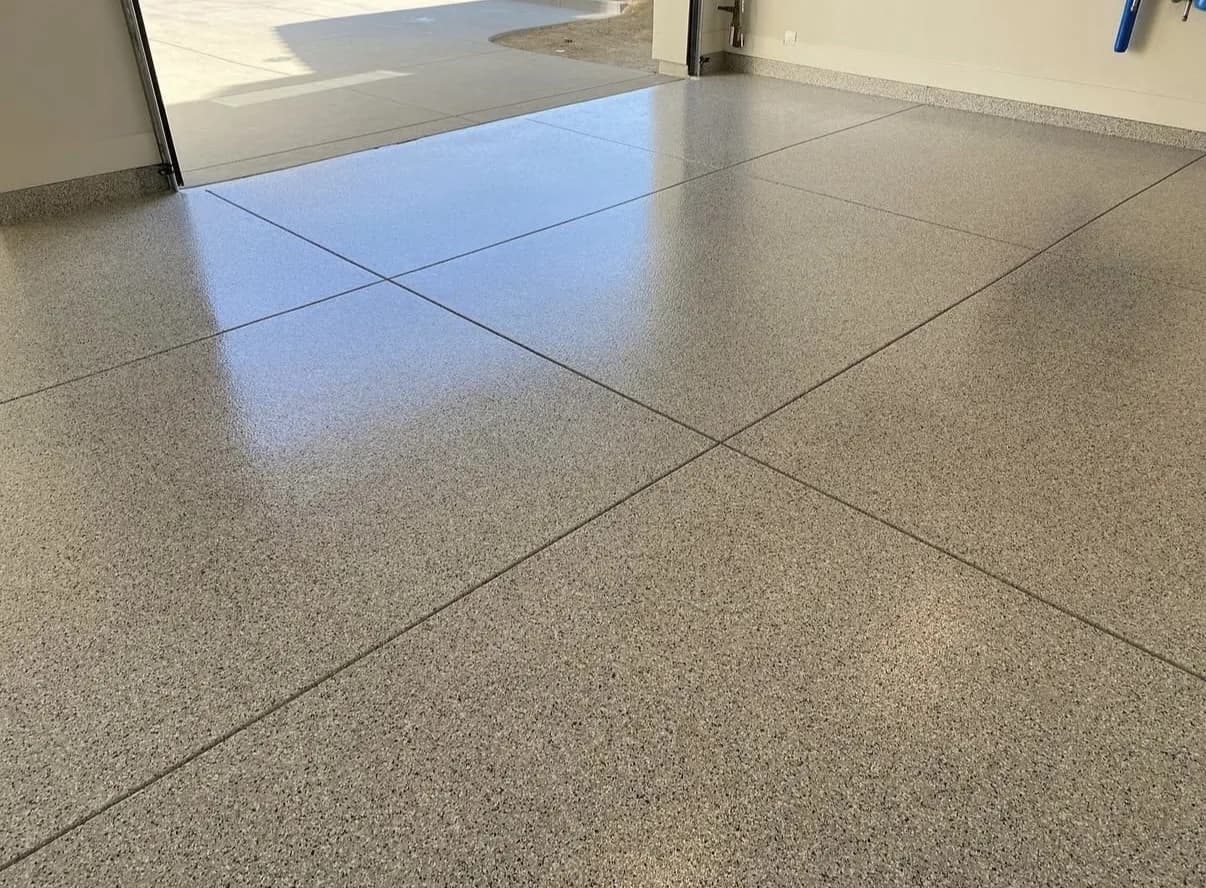
The control joints are still readable through the finish. They are part of the slab, not a defect in the floor. 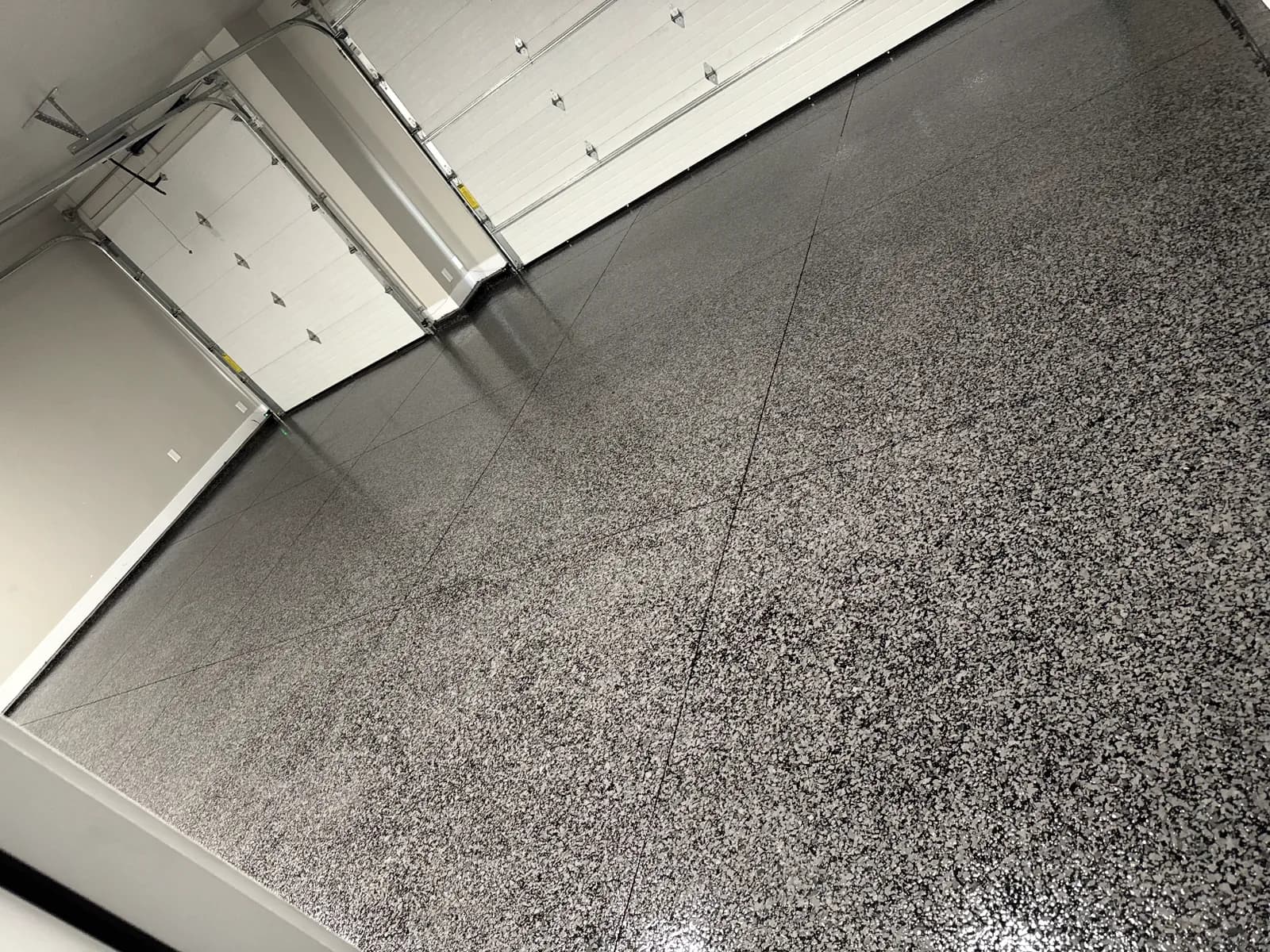
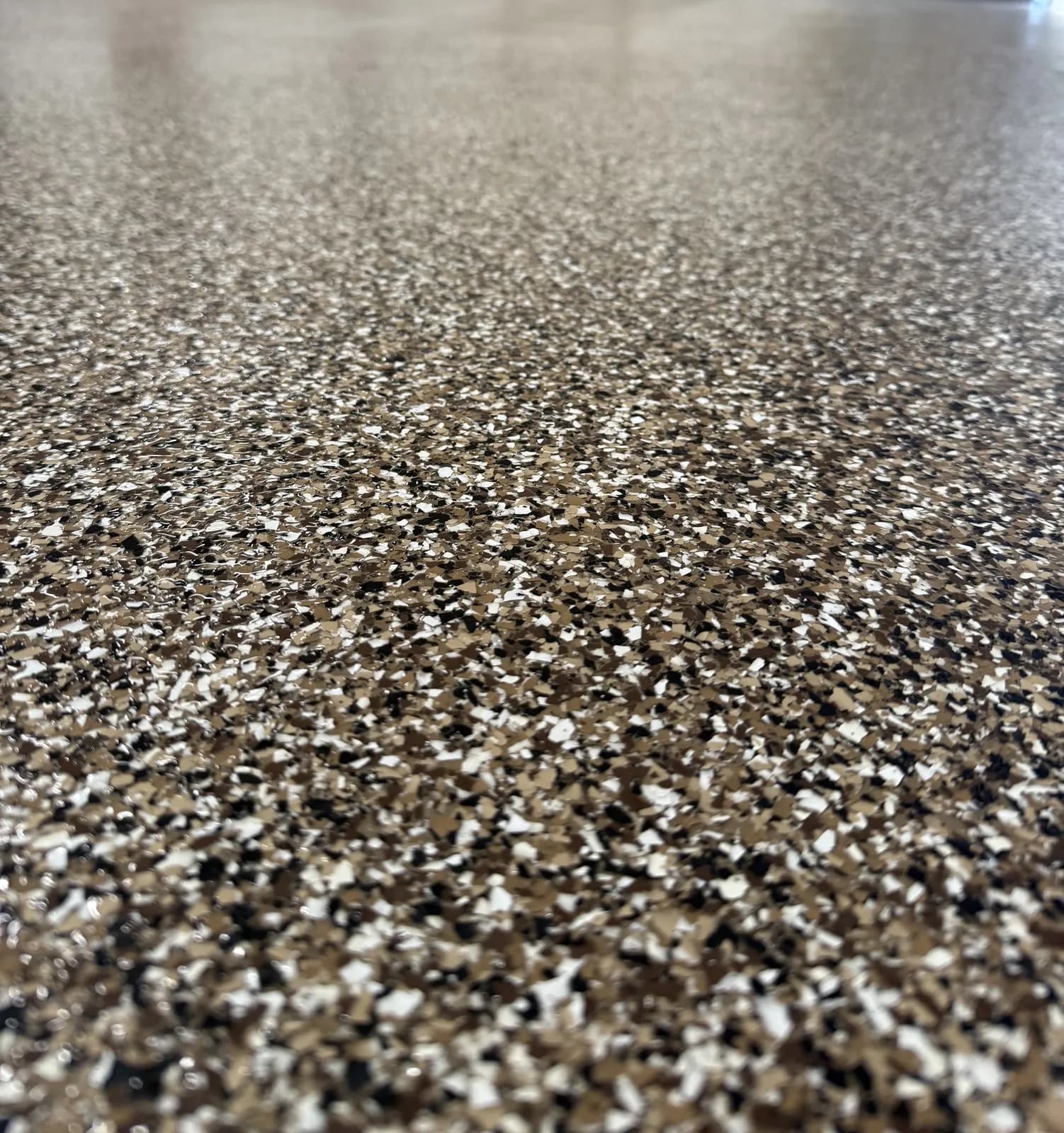
From above, where the coverage is easiest to judge. Close enough to see the individual chips under the clear coat. 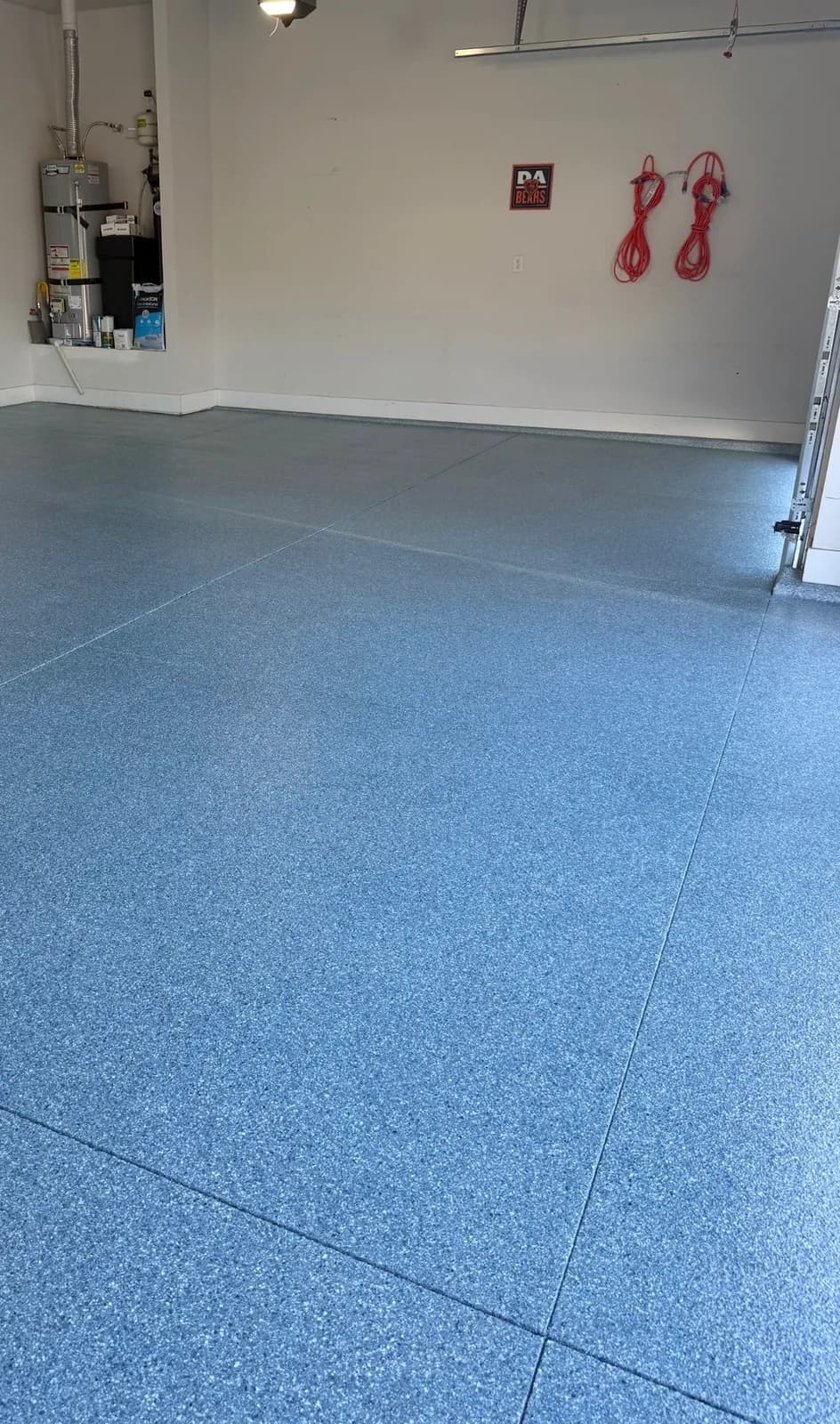
Flake is sold as a blend, and the blend is chosen. This one is blue. 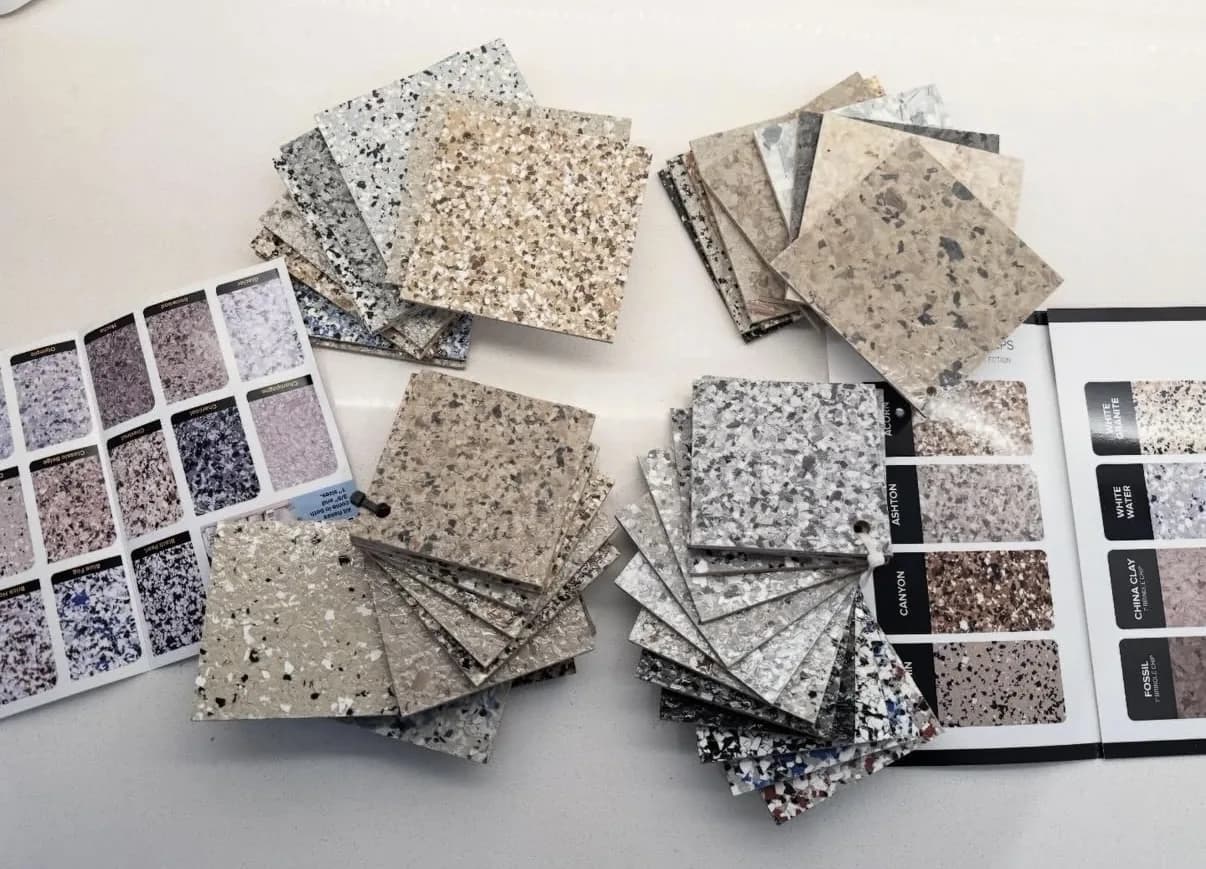
The blends, as samples. Pick from the chip in daylight, not from a photograph on a phone. 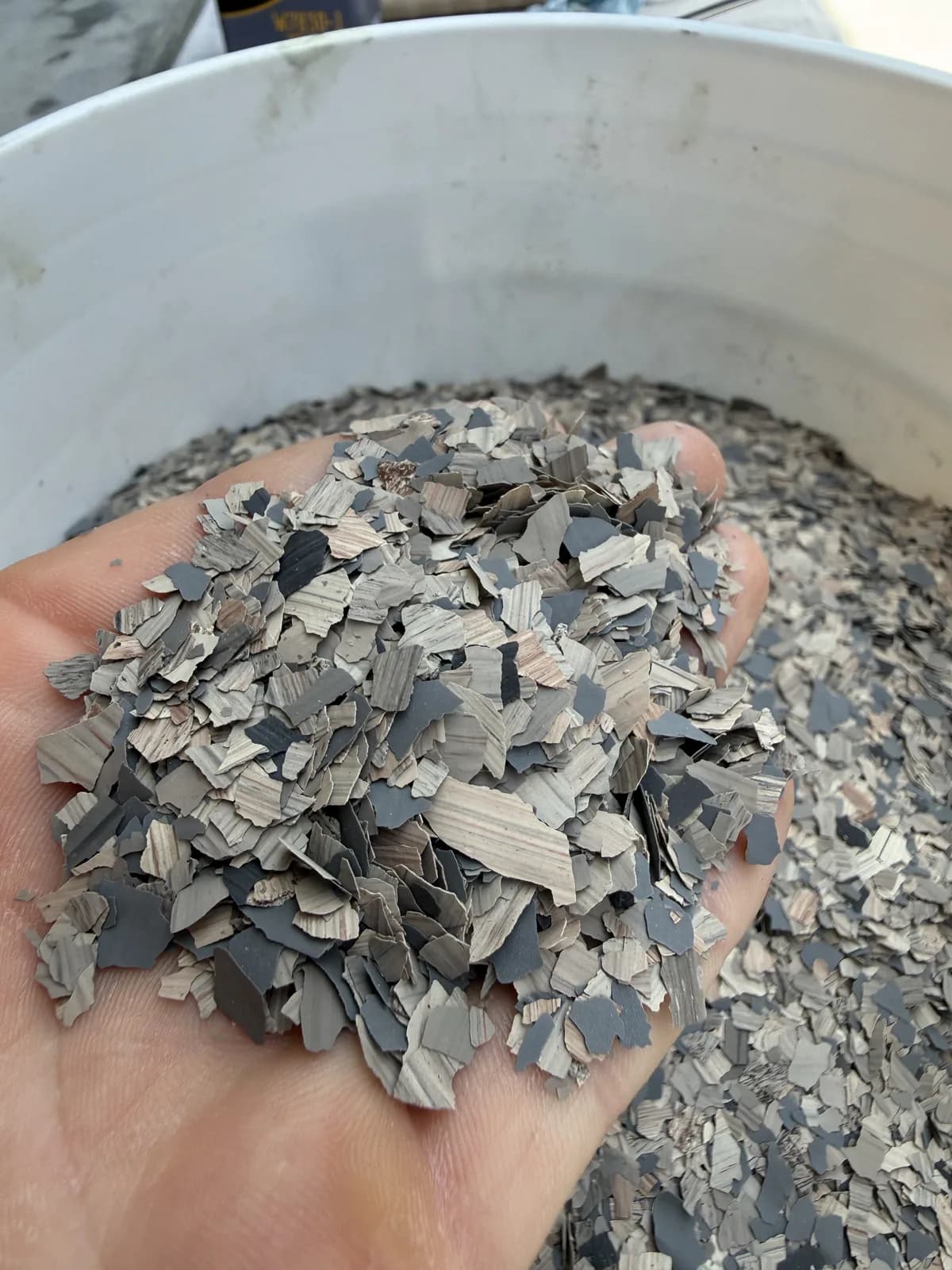
The chips before they are thrown. They are vinyl, and they go on by hand.
12 more photographs
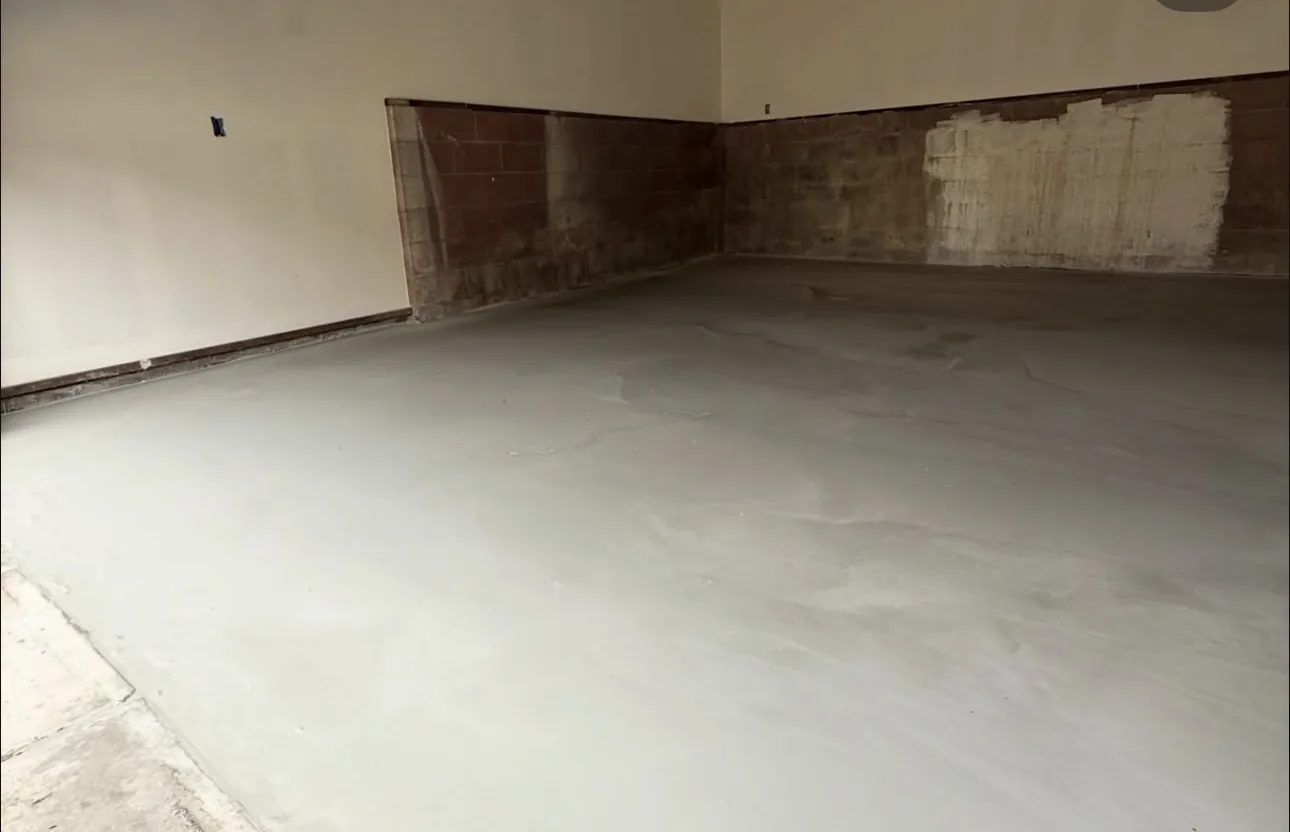
The base coat, still wet. The flake goes into this, not onto it, which is why there is no second chance at the timing. 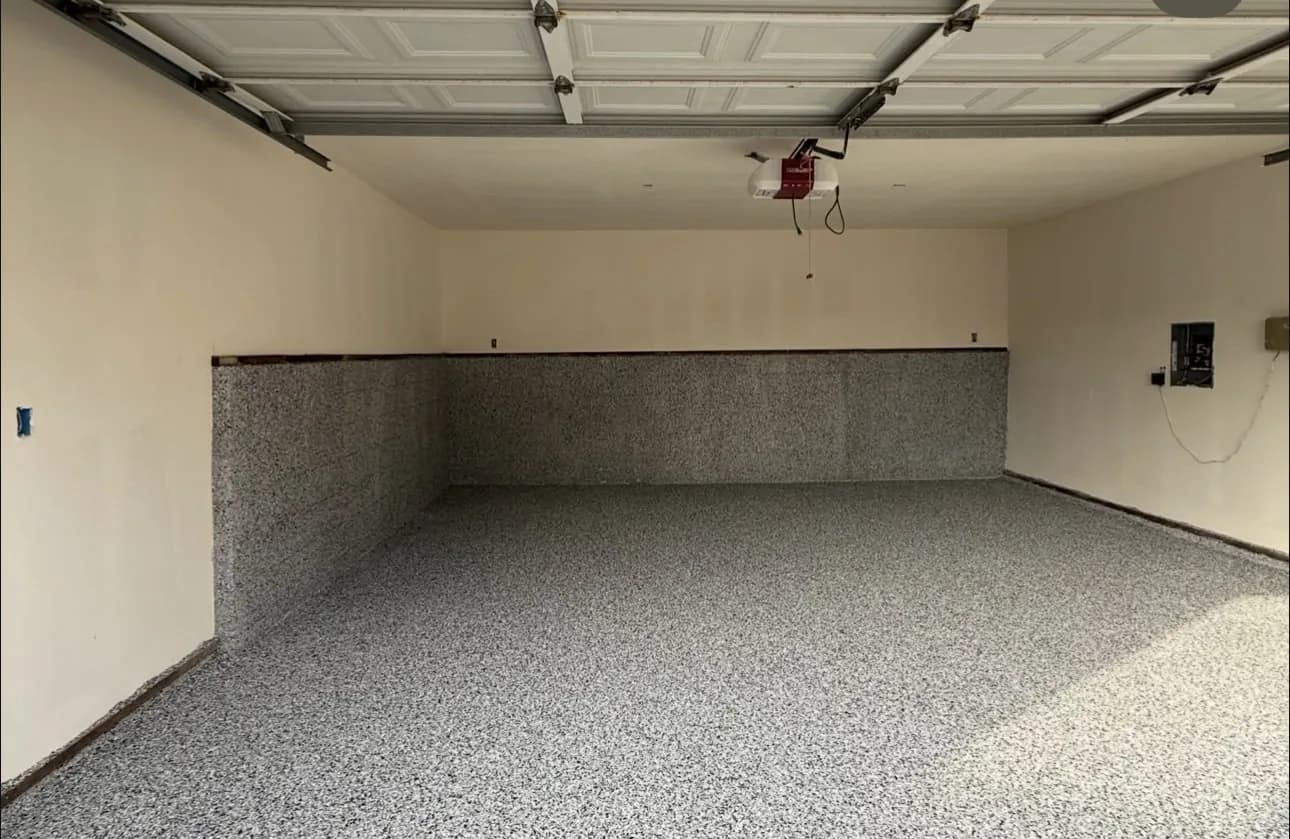
The coating carried up the wall as a base, so there is no open joint at the floor line for water to sit in. 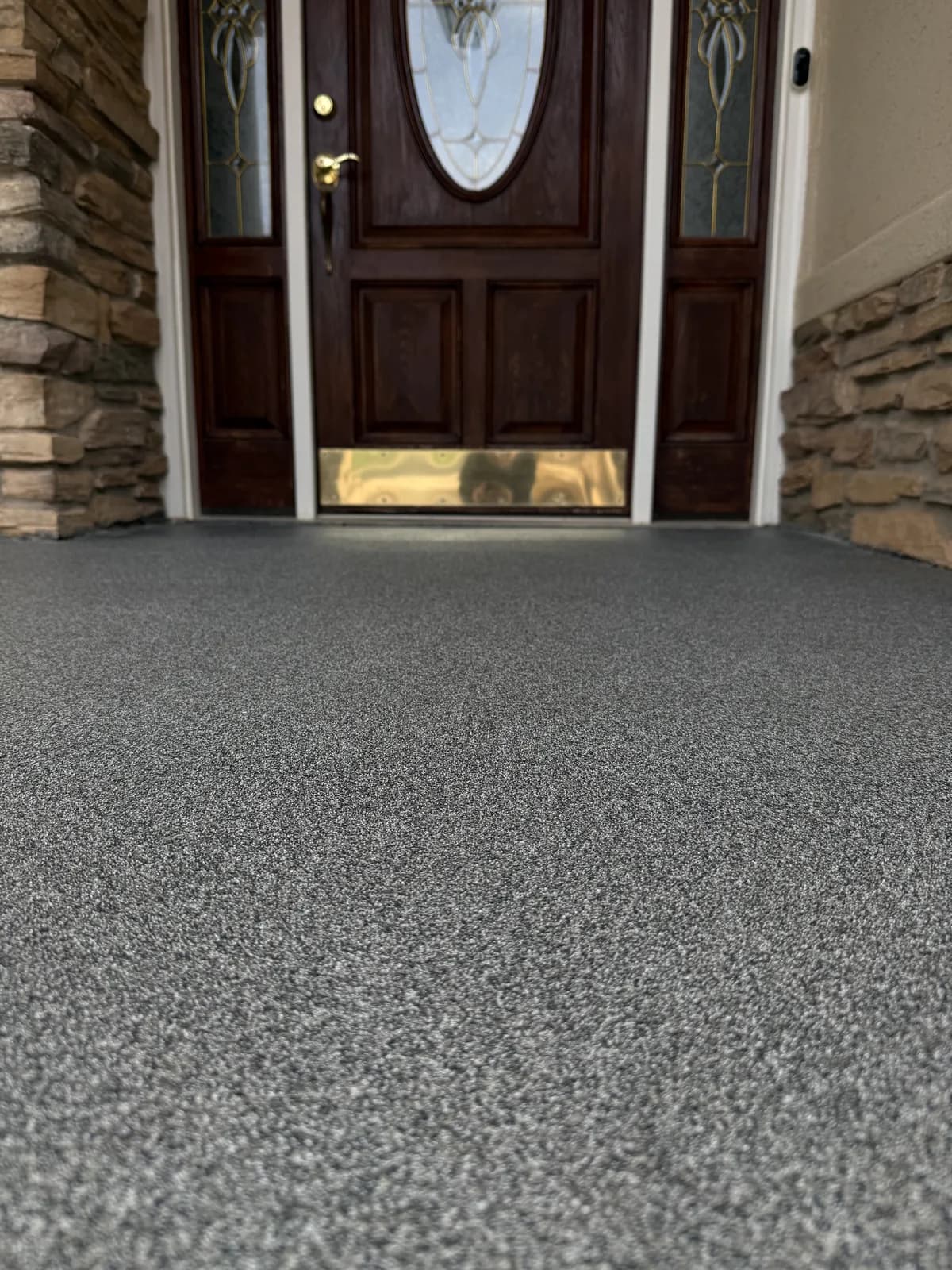
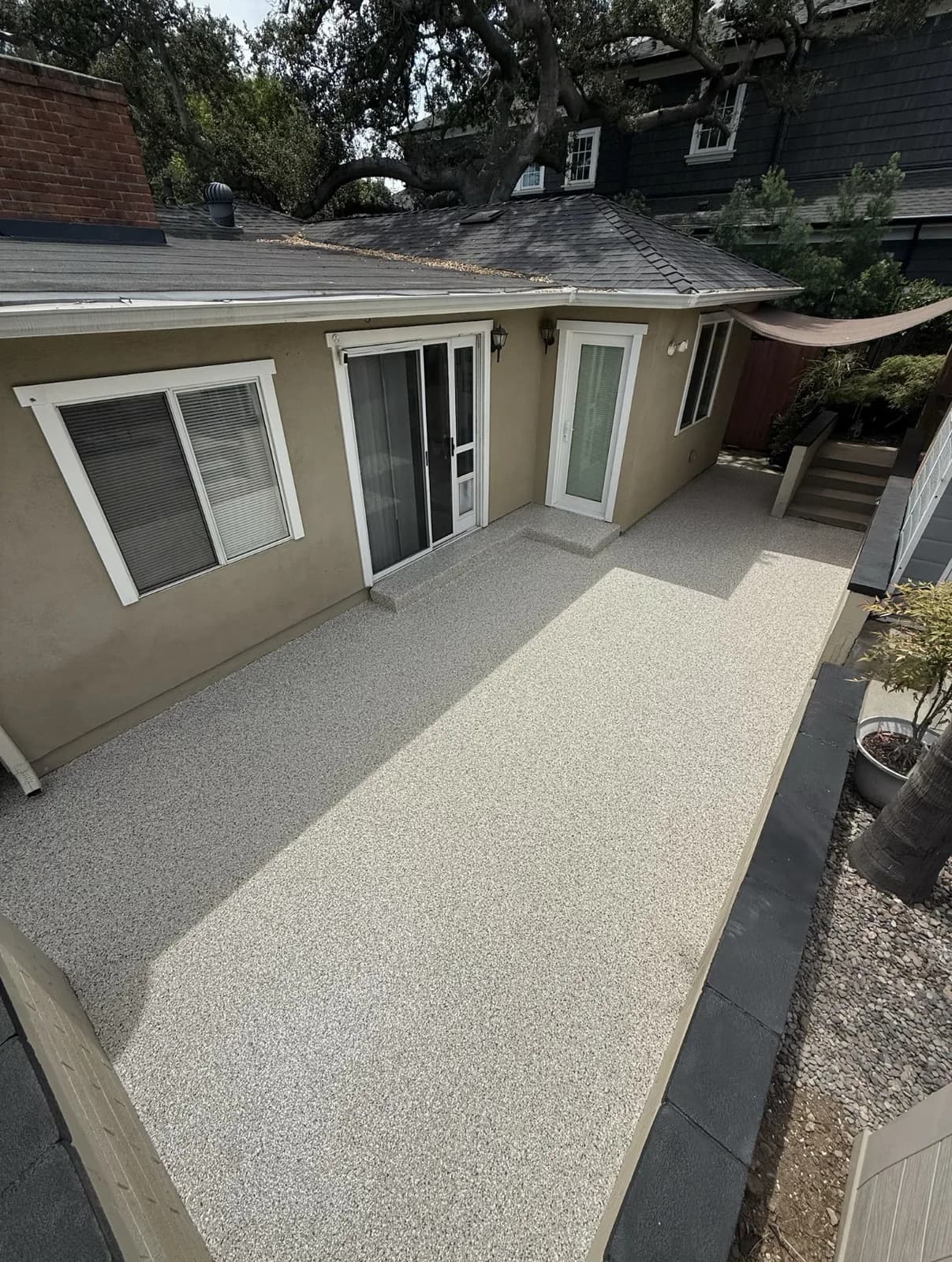
An entry porch. The finish here is a fine broadcast rather than large flake. 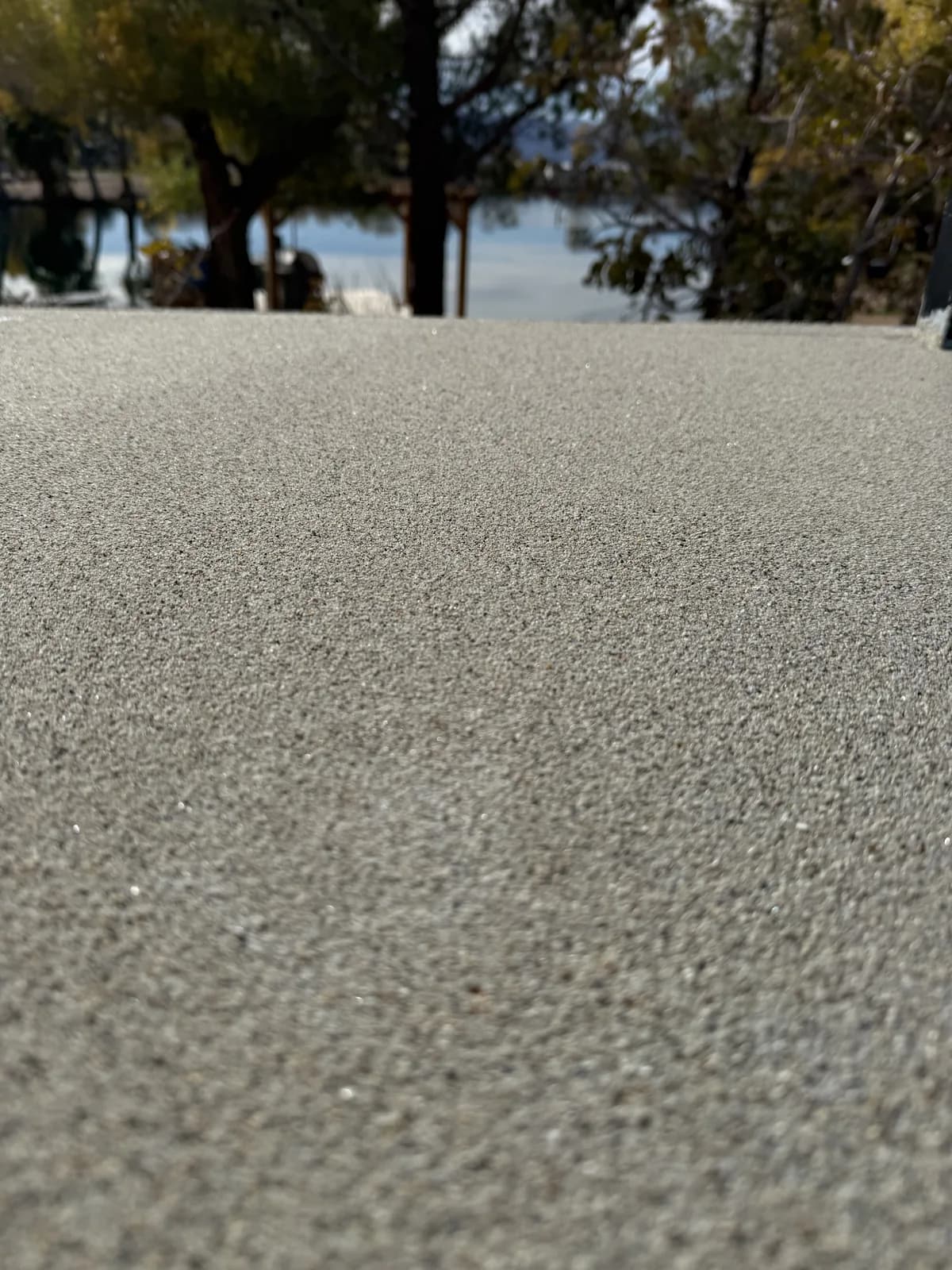
A quartz broadcast, close up. Coarser than flake, and meant to be. 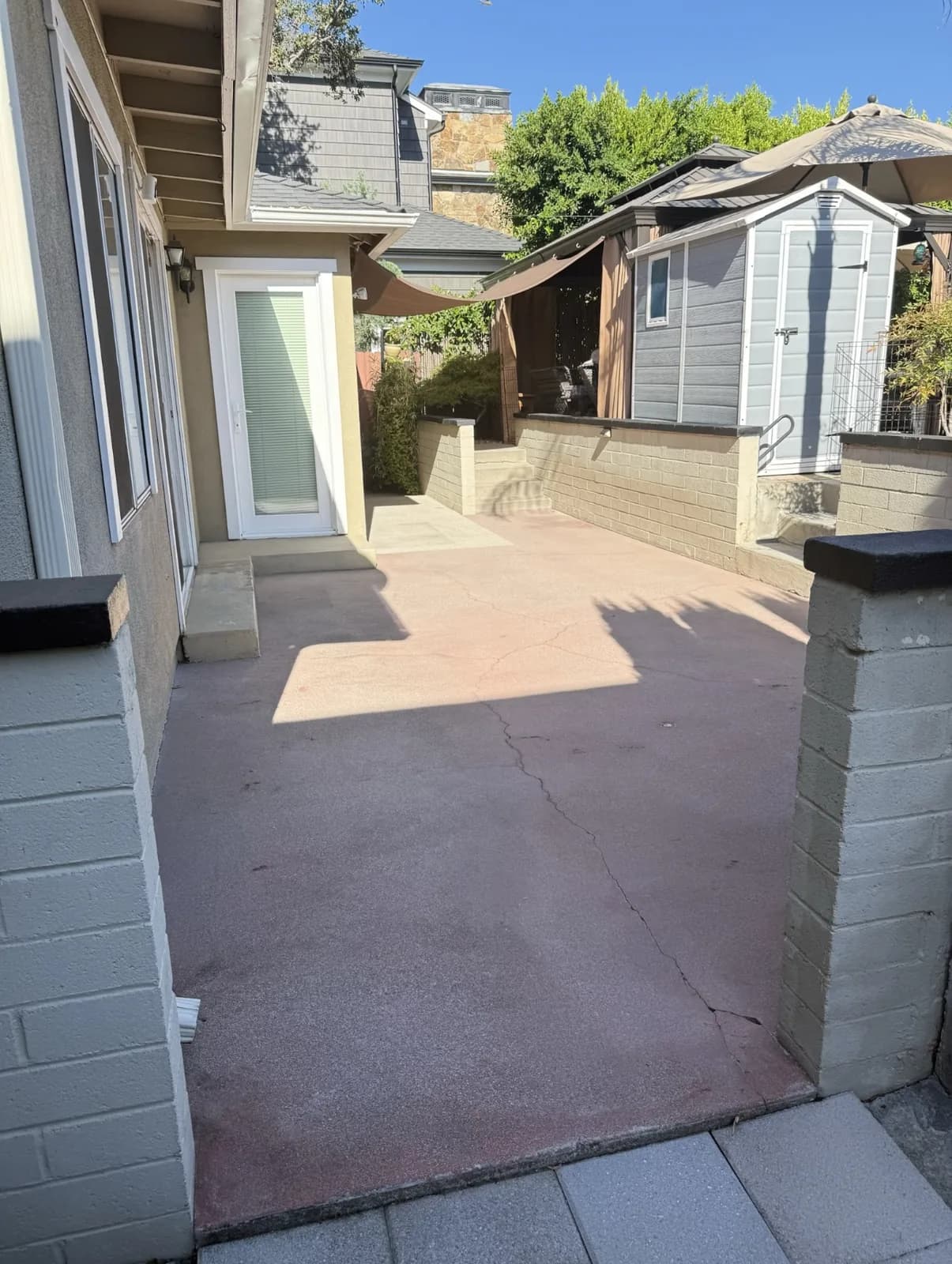
Before, elsewhere. The pale lines are earlier repairs, not cracks in a coating. A finished patio, resurfaced over the slab that was already there. 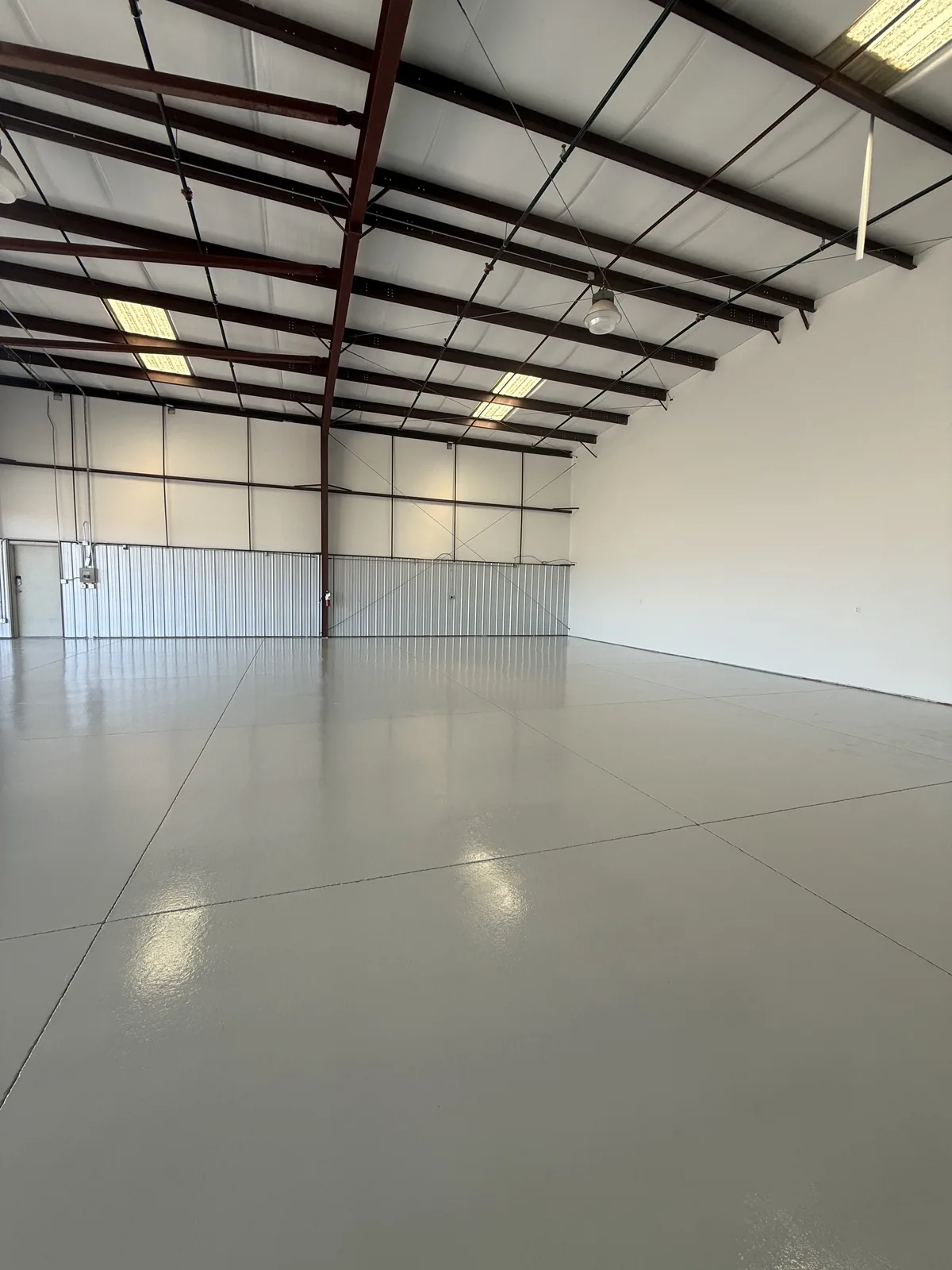
A solid color with no flake. It is the plainest finish and it shows every repair in the slab beneath. 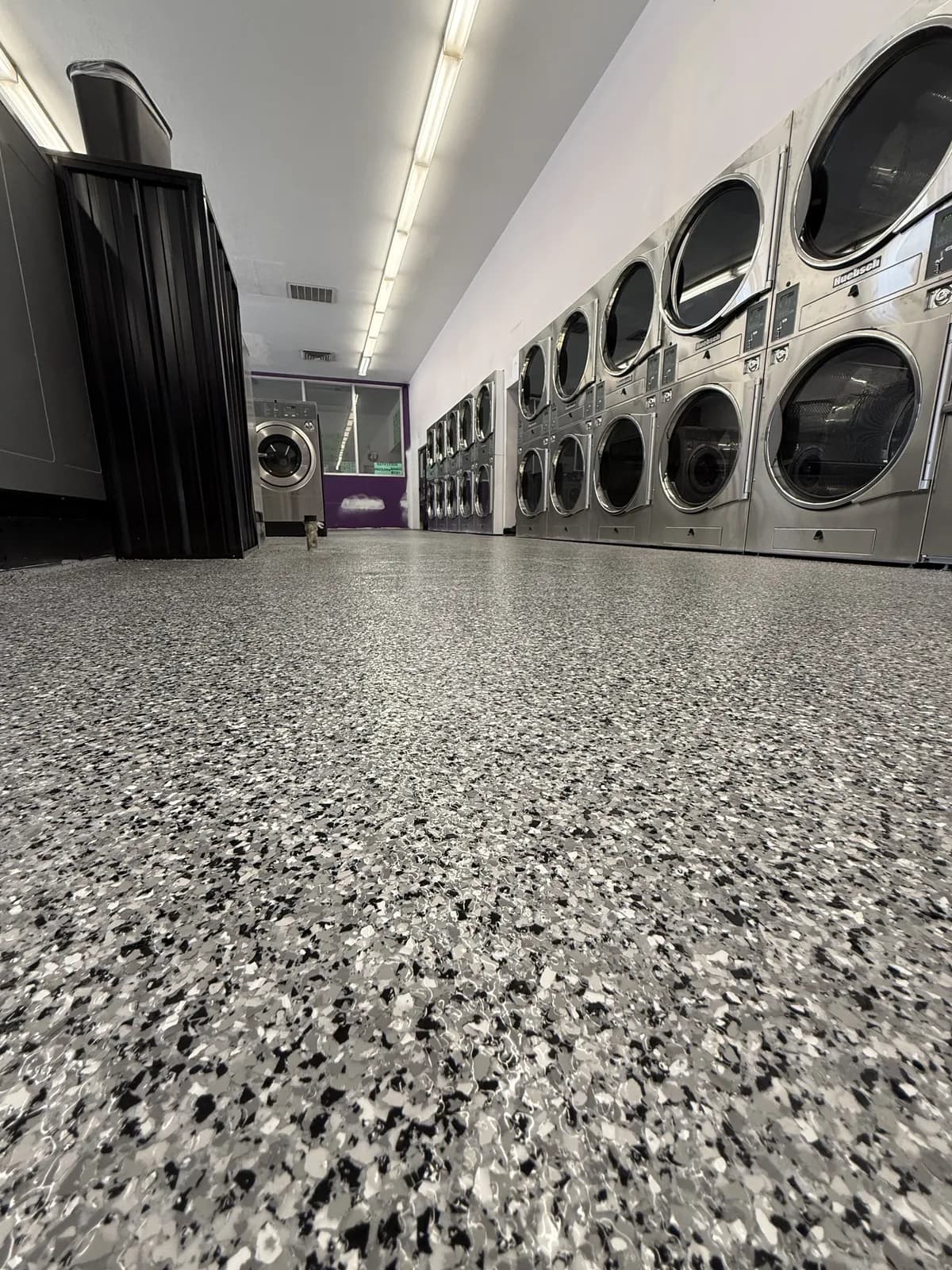
The same floor from floor level. 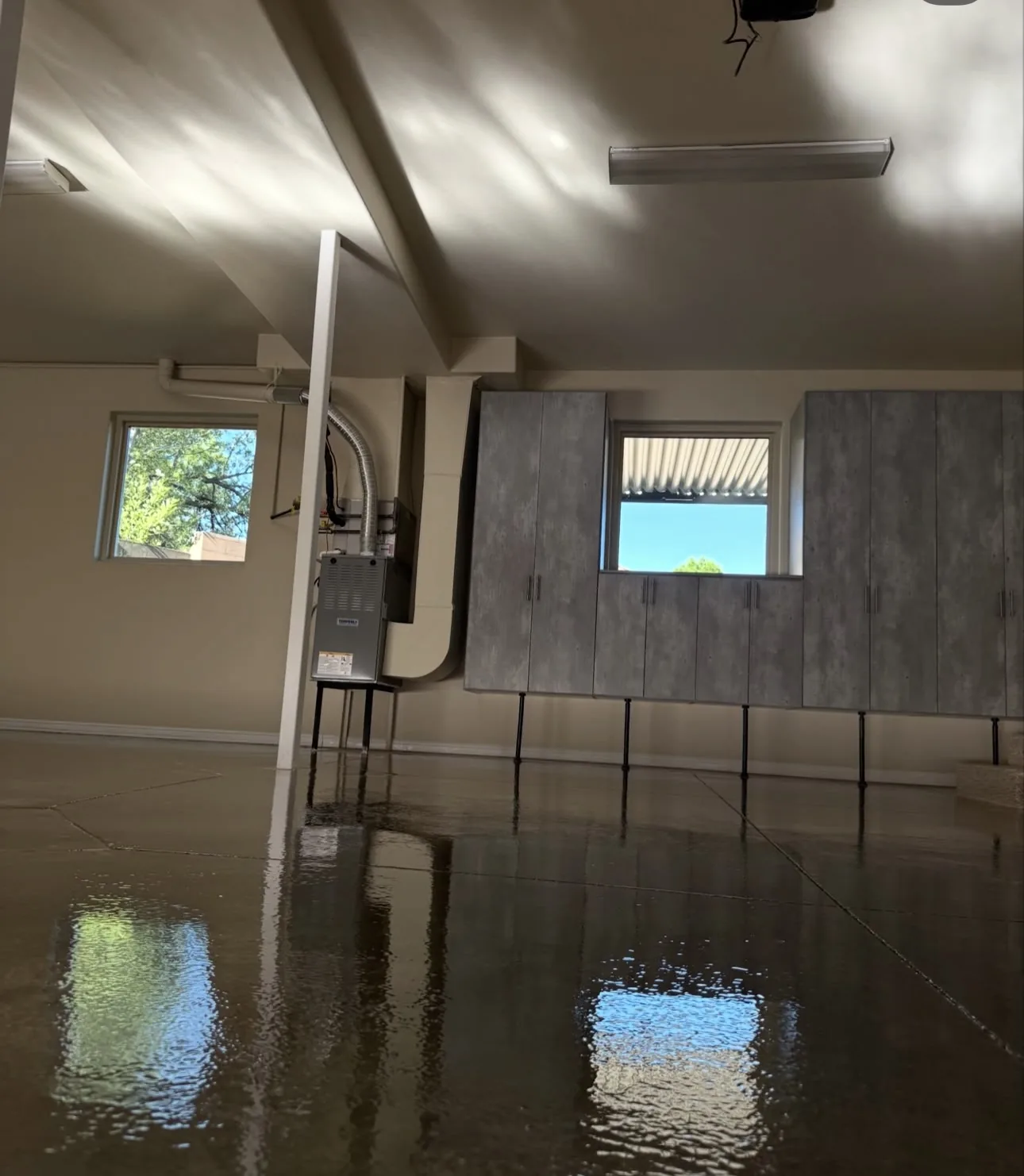
Washed down. The mirror is water, not a finish. 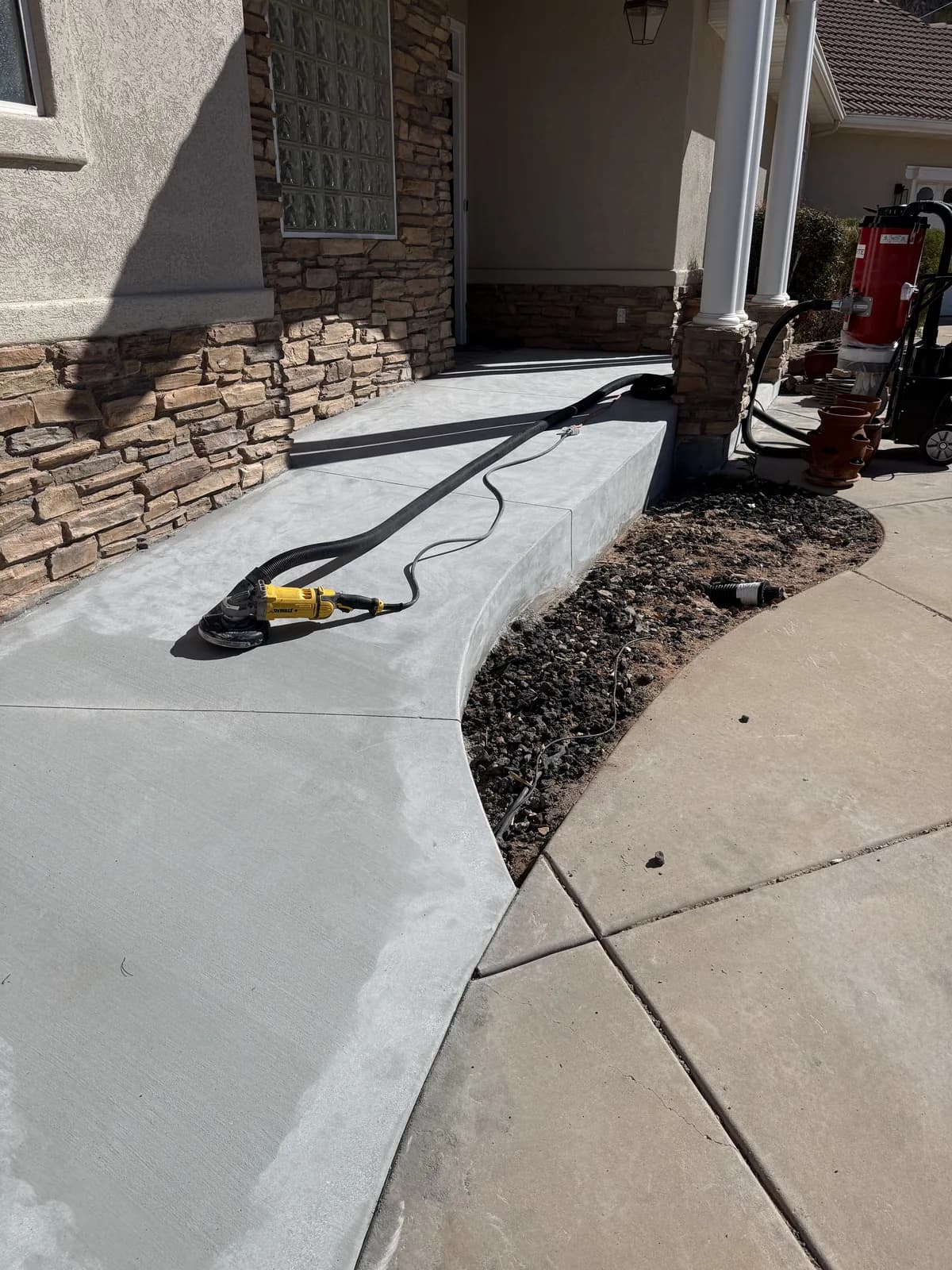
A walkway and step ground back before anything is applied. The hand grinder is for the edges the big machine cannot reach. 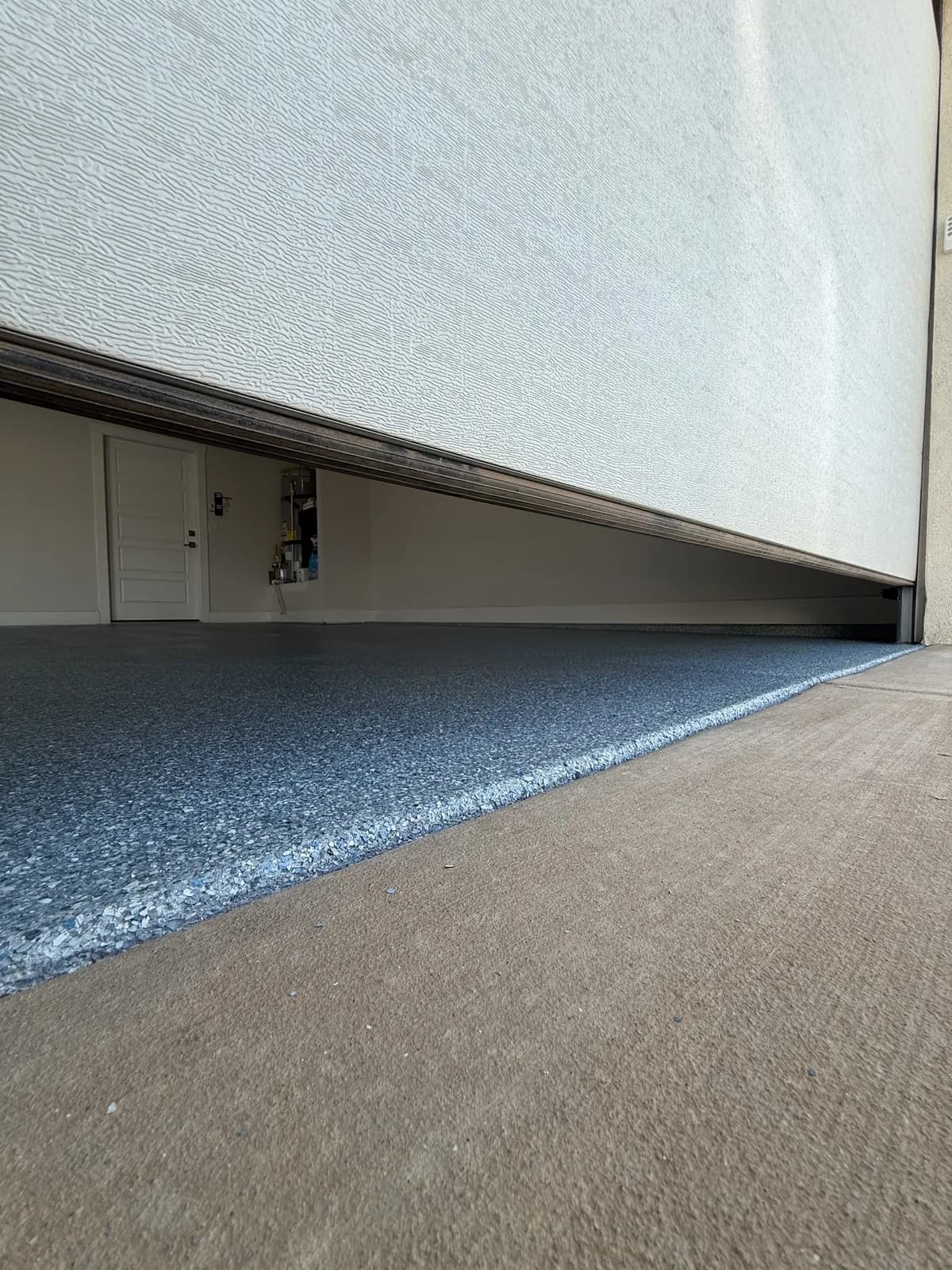
The edge at the threshold, which is where a floor is finished well or is not. 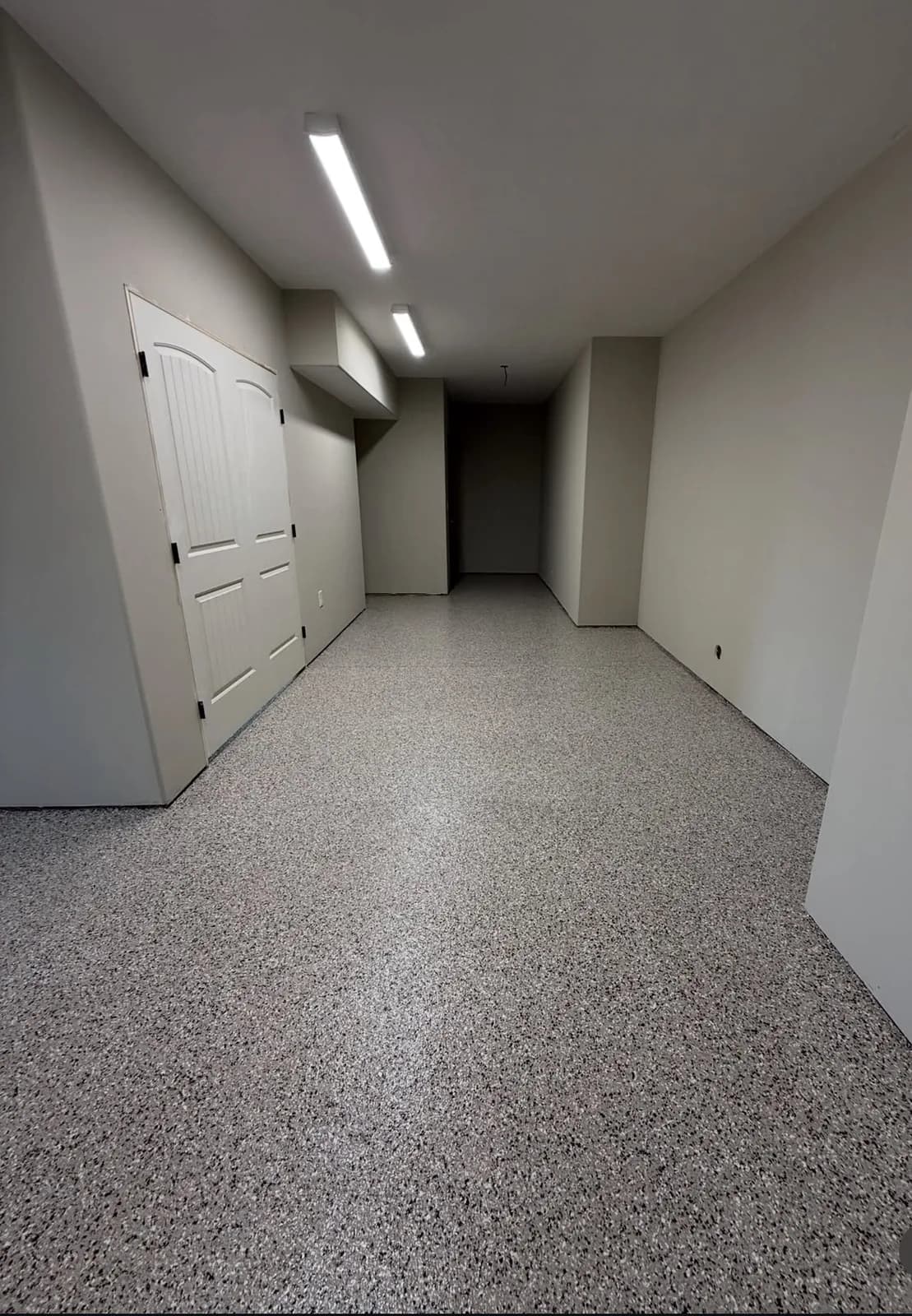
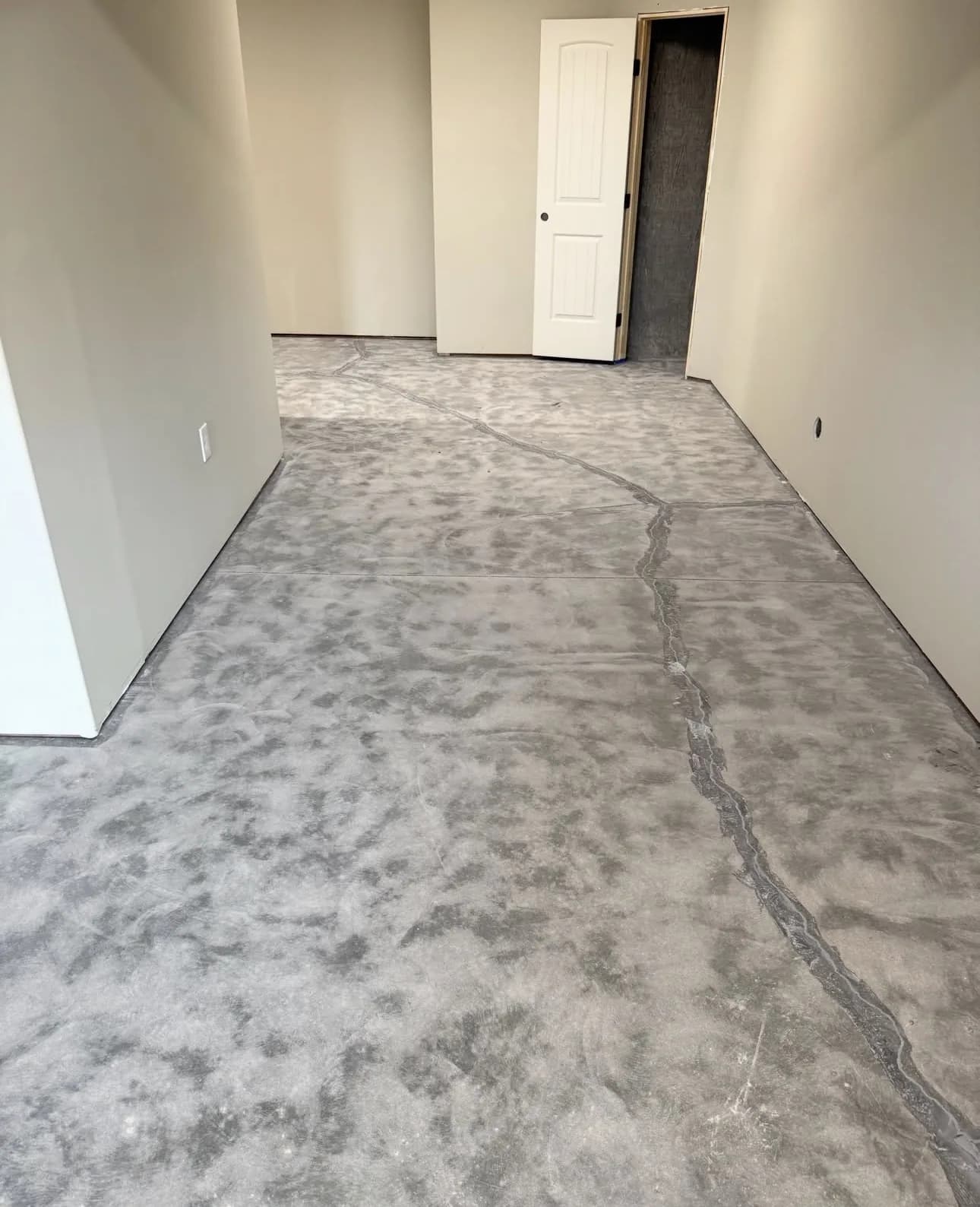
A basement corridor. Finished concrete is a floor here, not a subfloor waiting for one.
51 photographs in the library, across the pages under this one.
Questions we get asked
Four of these do not have an answer yet, and they are the four everybody else answers with a number. Where that is the case it says so and says why.
What does a garage floor cost?
There is no price on this page, and there will not be one until it is a number that holds on the fiftieth job rather than the easiest one. A published price that gets broken is a deceptive practice, not a bad review.
What decides it is the slab, not the square footage: how much grinding it needs, what is already on it, what the cracks are doing and what the moisture reads. That is why we look before we quote, and why a price quoted over the phone from a room size is a guess.
How long will it last?
Most pages selling this in Washington County say fifteen to twenty years. We have not been able to trace that figure to a manufacturer, a standard or a study, so we are not going to repeat it.
What we can tell you is what decides it, and it is not the brochure. It is whether the laitance came off, whether the slab was tested for moisture, whether the cracks were repaired or covered, and whether the product going down is rated for the sun it will get. Those are all checkable before the work starts.
Is polyaspartic better than epoxy?
The honest answer is that “better” is the wrong frame, and that most of what is written about it online is written by people selling one of them.
Ultraviolet stability is a property of a specific product, and the manufacturer publishes it. Sherwin-Williams describes polyaspartic floor coating as part of the urethane family and offering “UV-resistant, color-stable protection”; its aliphatic polyaspartic products state UV stability by name on the data sheet. That is checkable, which means its absence is checkable too.
So the question to ask is not which chemistry. It is which product is going on my floor, and what does its data sheet say. Ask us, and ask anyone else quoting you.
How long before I can park on it?
That is set by the product and by the temperature of the slab, and it is printed on the data sheet for the specific system going down. You will be told it before the work starts, in writing, alongside the date.
We are not going to print a number here. “One day” is the industry’s favorite claim and it is true of some systems, in some conditions, at some temperatures. A slab at 105°F and a slab at 45°F are not the same job.
Can you go over my existing coating?
Only if we can establish what it is and that it is sound, and usually we cannot. The safe answer is that it comes off. More to the point, if a coating has already failed once, the first job is finding out why — because a new one over the same unaddressed cause fails the same way. That is its own job and we price it as one.
Do I have to empty the garage?
Yes, completely, and it is the part people underestimate every time. The floor is ground wall to wall, so nothing can stay in it — including the things on shelves, because grinding dust reaches them. We will tell you exactly what has to be out and by when, and we would rather have that conversation a week early than on the morning.
Will the cracks come back?
A crack that is not moving is repaired and stays repaired. A crack that is moving — because the slab is settling, heaving or built over something that is — will telegraph back through any coating, usually within a season. We look at what the cracks are doing before quoting anything over them, and if the answer is that the slab is moving, we will tell you that a coating is money spent twice rather than take the job.
Does my HOA have to approve it?
Your documents are the only authority and we are not going to guess at them. As a general shape: the inside of a garage is almost never an association’s business, and an exterior surface visible from the street sometimes is. We will read yours before you commit. Our HOA pages cover what the recorded documents in the larger communities here actually say.
Is it slippery?
It depends entirely on the finish, and that is a decision rather than an accident. A full flake broadcast has real texture and grips well wet. A smooth solid color or a metallic does not, which is why we will not put a metallic on a pool deck even if you ask for one. Outside, texture comes before color in the conversation, every time.
Do you do commercial work?
Yes — retail and showroom floors, warehouses, shops and service bays. The technical job is the same; what changes is that the schedule belongs to you. Work gets sequenced in sections, overnight or across a closure you choose, and which of those applies changes the price openly rather than quietly. Commercial floor coating and warehouse floors have the detail.
The quote is the number. There is no second number.
Call (435) 850-0053
7 a.m. to 5 p.m., weekdays. Emergency calls answered any hour, every day.