
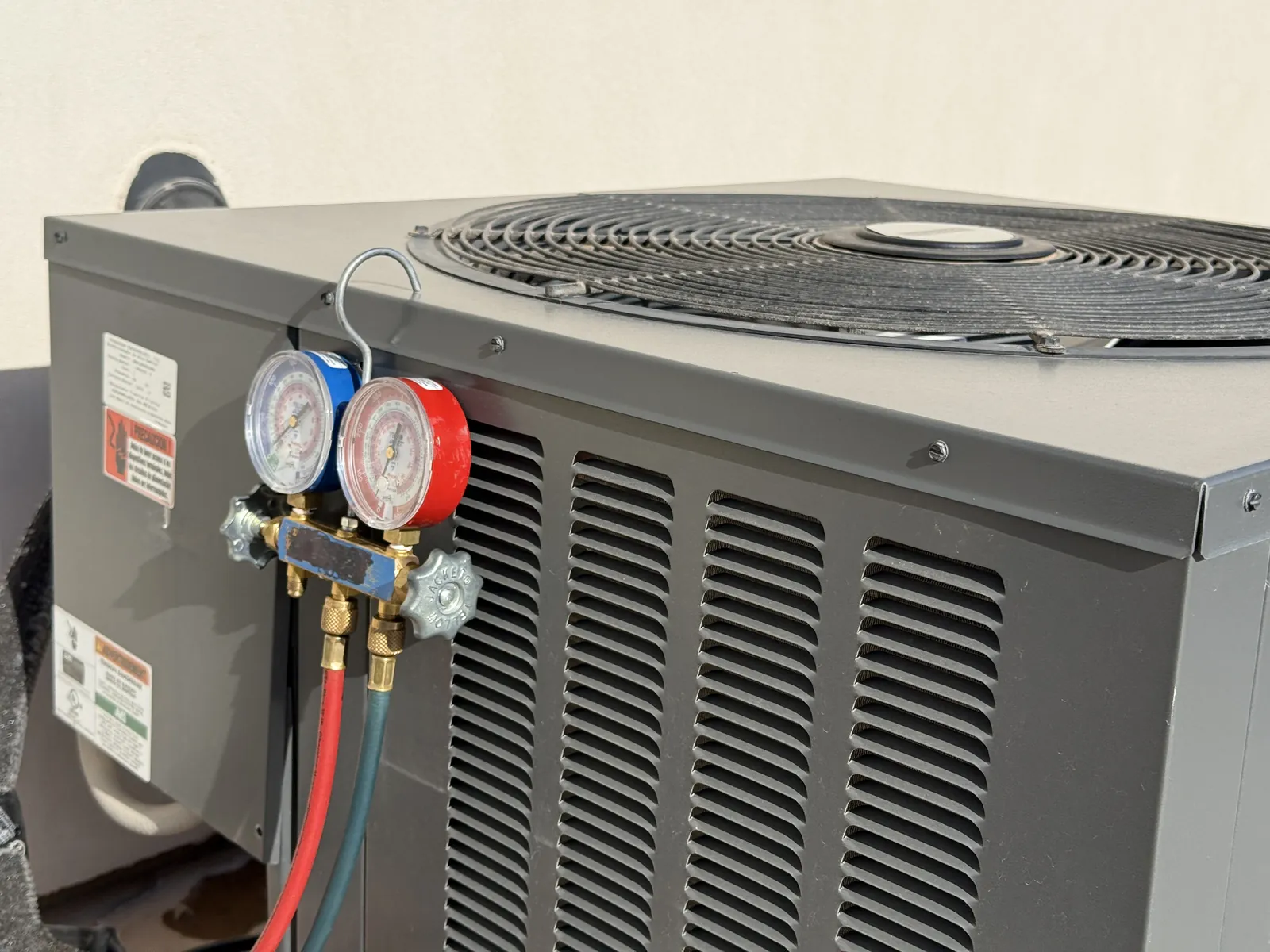
What the work is
The failure is usually one of a short list: a capacitor, a contactor, a blower or condenser fan motor, a control board, or refrigerant that has gone somewhere it should not have. Which one it is changes the bill by an order of magnitude, so we find out before we quote.
You get told the part, the reading that condemned it, and the price. If the repair costs a serious fraction of a replacement on a system near the end of its life, we say that too, and then it is your decision, not ours.
Five things account for most of what we find. A capacitor that has drifted below its rated microfarads and can no longer start the compressor. A contactor with burned or welded points. A condenser fan motor that has seized or whose bearings have gone. A control board. Or refrigerant that is low, which is never a fault in itself — it is the symptom of a leak, and it is covered on its own page.
The order matters. Capacitors are cheap and they are the single most common failure, so they get measured first. A contractor who opens with a compressor or a coil has skipped the cheap answers, and a compressor quote on a system that needed a thirty-dollar part is the most expensive mistake available in this trade.
You get the measurement either way. If the capacitor reads inside tolerance we tell you that and move on, rather than replacing it because it is easy to sell.
What is included
- Measured readings, not a look and a verdict
- The failed part named, and the number that condemned it
- One price for the repair, agreed before it starts
What is not
- Replacing parts that measure fine, on the theory that it might help
- Adding refrigerant without finding where it went
- A compressor or coil quote before the cheap failures have been measured and ruled out
The week it breaks is the week you need it
St. George recorded 98 days at or above 100°F in 2024, the most on record, with back-to-back hottest Julys in 2023 and 2024. The all-time high is 117°F.
Equipment fails under load, which means it fails in July, which means everyone in the county is calling the same week. That is worth knowing when you are deciding whether to have something looked at in April. A capacitor that measures low in spring is a scheduled visit; the same capacitor in July is an emergency call.
What to ask anyone quoting this, us included
- What did you measure, and what should that reading have been?
- Is this a repair or the first of several on a system that is finished?
- Is the diagnostic credited against the repair?
- Did you measure the capacitor, and what did it read against its rating?
- What is the age of the system, and does that change your advice?