St. George Home Services

Plumbing · Water heaters

Tankless like-for-like swap

Replacing an existing tankless where the gas line and the venting already suit the new unit. Cheaper than a first install, and we check that assumption before we quote it that way.

One flat fee to find out what is wrong. You are told it on the phone before anyone is dispatched, and it comes off the job if you hire us. Read our Plain Terms

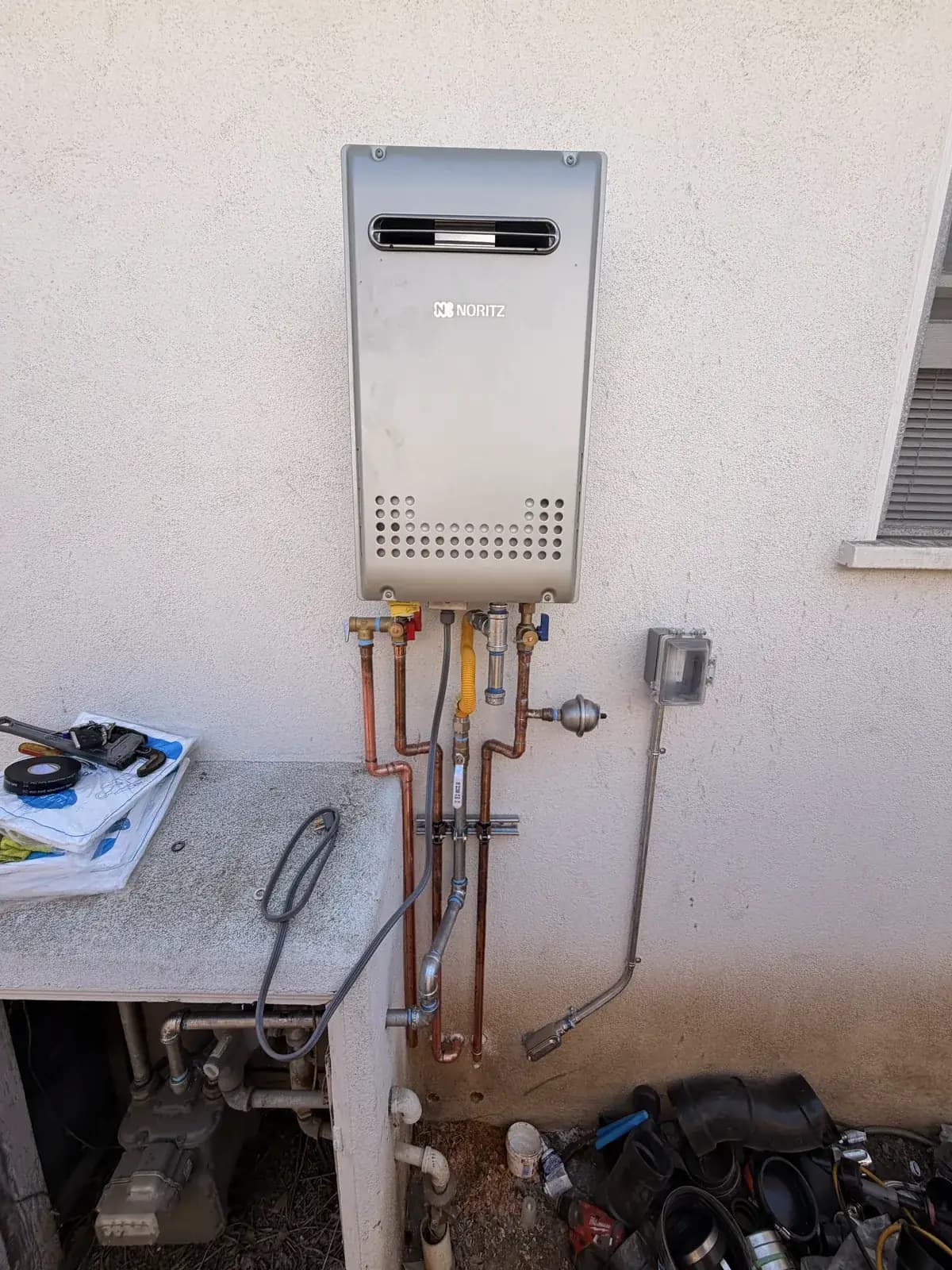
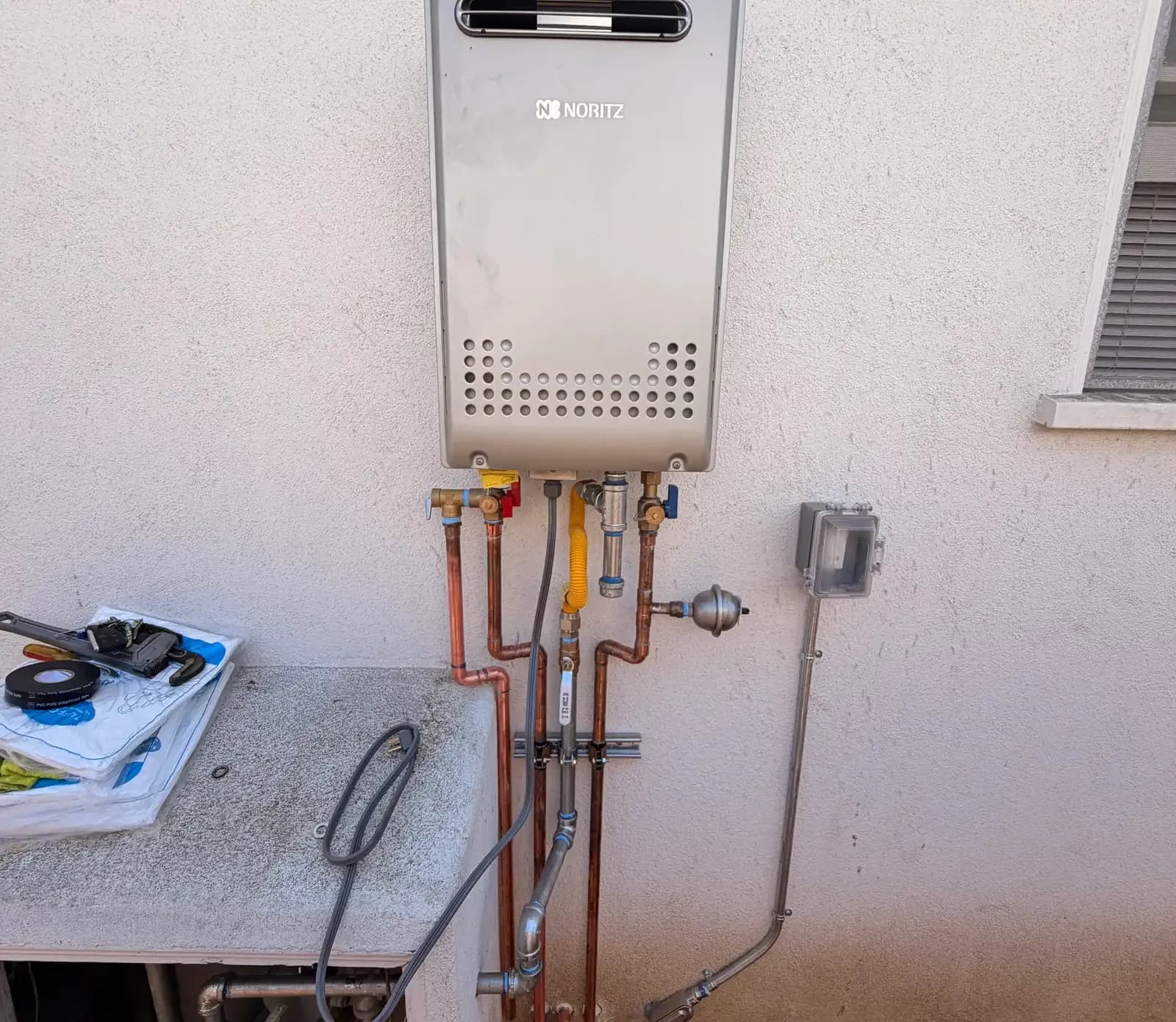
A wall-mounted tankless water heater on a stucco exterior wall with copper hot and cold lines, red and blue isolation valves, a yellow corrugated gas connector with its own shutoff, a condensate drain and a weatherproof electrical disconnect
An exterior tankless with isolation valves, so it can be descaled without cutting anything. Southern California.

What the work is

If a tankless is already there, most of the expensive work was done once. The gas is sized, the vent is run, the condensate has somewhere to go. Swapping the unit is then a day's work.

The check that matters is whether the new unit is actually equivalent. Venting material and diameter, gas demand at full fire, and condensate requirements all change between models and between condensing and non-condensing units. We verify against the new unit's manual, not against the fact that something worked there before.

If the existing install was wrong, we will tell you. Replacing a unit onto an undersized gas line just moves the problem to a newer heater.

What is included

  • Removing the old unit and setting the new one
  • Reusing the existing gas, vent and condensate where they meet the new unit's specification
  • Adding isolation valves if the old install lacked them
  • Commissioning to the manufacturer's start-up procedure
  • The permit where one is required
  • Hauling the old unit away

What is not

  • Upsizing gas or replacing venting, if the new unit needs more than the old one had. Quoted before we start
  • Water treatment
  • Correcting other people's work beyond what the swap requires, unless you ask us to

Why the old one failed matters

If the unit you are replacing failed early, find out why before you buy the same again. On this water the usual answer is scale in the heat exchanger from a unit that was never descaled, or was installed without the isolation valves that make descaling affordable.

A swap that does not address that buys you the same failure on a longer timescale.

What to ask anyone quoting this, us included

  • Does the new unit need the same gas and vent as the old one?
  • Why did the old one fail?
  • Are isolation valves on it now?

What we can show you in writing

Every line traces to a document we read in full. The number after a sentence points to the research below.

  • The City of St. George's Water Distribution Division instructs residents to set water softeners to 18 grains per gallon, with a maximum of 22 grains.1
  • A.O. Smith's gas tankless warranty excludes damage from hard water over 7 grains per gallon in a single-family home. St. George runs 18 to 22.2
  • Noritz voids outright above 12 grains per gallon.2
  • Rinnai's manual states it flatly, and separately tells you a hard-water area needs treatment and more frequent flushing.2
  • Rheem excludes heat exchanger failures caused by scale, and Navien excludes damage from hard water deposits and mineral build-up.2
  • Rinnai and Rheem also void on hours, not just years: both stop at 12,000 operating hours, whichever comes first. A scaled unit runs longer per gallon delivered, so hard water spends that clock faster too.2
2 more facts, with sources
  • These are exclusions on the damage, not a blanket void of the whole warranty. A manufacturer denies a scale-related heat exchanger claim; it does not normally void an unrelated control board failure.2
  • Softening is what clears the limits. Softened output runs about 0 to 1 grain per gallon, under every threshold above. The 18-grain figure is what you tell the softener is coming in, not what comes out of it.2

Where this comes from

Every line above traces to a document we read in full. The number after a sentence points to the research below; hover it for the section. If you find a line wrong, tell us and we will fix it and say so.

  1. Environment, water and ground research, August 2026 Compiled from the cities' own water quality reports, Utah Geological Survey Special Study 127, the Utah State Hazard Mitigation Plan, Washington County GIS hazard layers, NOAA climate records, EPA radon zones and Census QuickFacts. 1 section cited. Hover a number above for the section.
  2. Plumbing research, August 2026 Compiled from manufacturer warranty documents and installation manuals (A.O. Smith, Noritz, Rinnai, Rheem, Navien, Bradford White), the Battelle / Water Quality Research Foundation study, the Utah Code and DOPL rules. 4 sections cited. Hover a number above for the section.

Read before you decide

The rest of water heaters

The quote is the number. There is no second number.

Call (801) 680-6859

7 a.m. to 5 p.m., weekdays. Emergency calls answered any hour, every day.