
Permanent lighting is booking now for the holidays.

See permanent lighting
St. George Home Services

Heating and air · Keeping it running

AC condenser cleaning

The outdoor coil washed and the fins straightened, so the unit is not fighting the summer with a blanket on.

One flat fee to find out what is wrong. You are told it on the phone before anyone is dispatched, and it comes off the job if you hire us. Read our Plain Terms

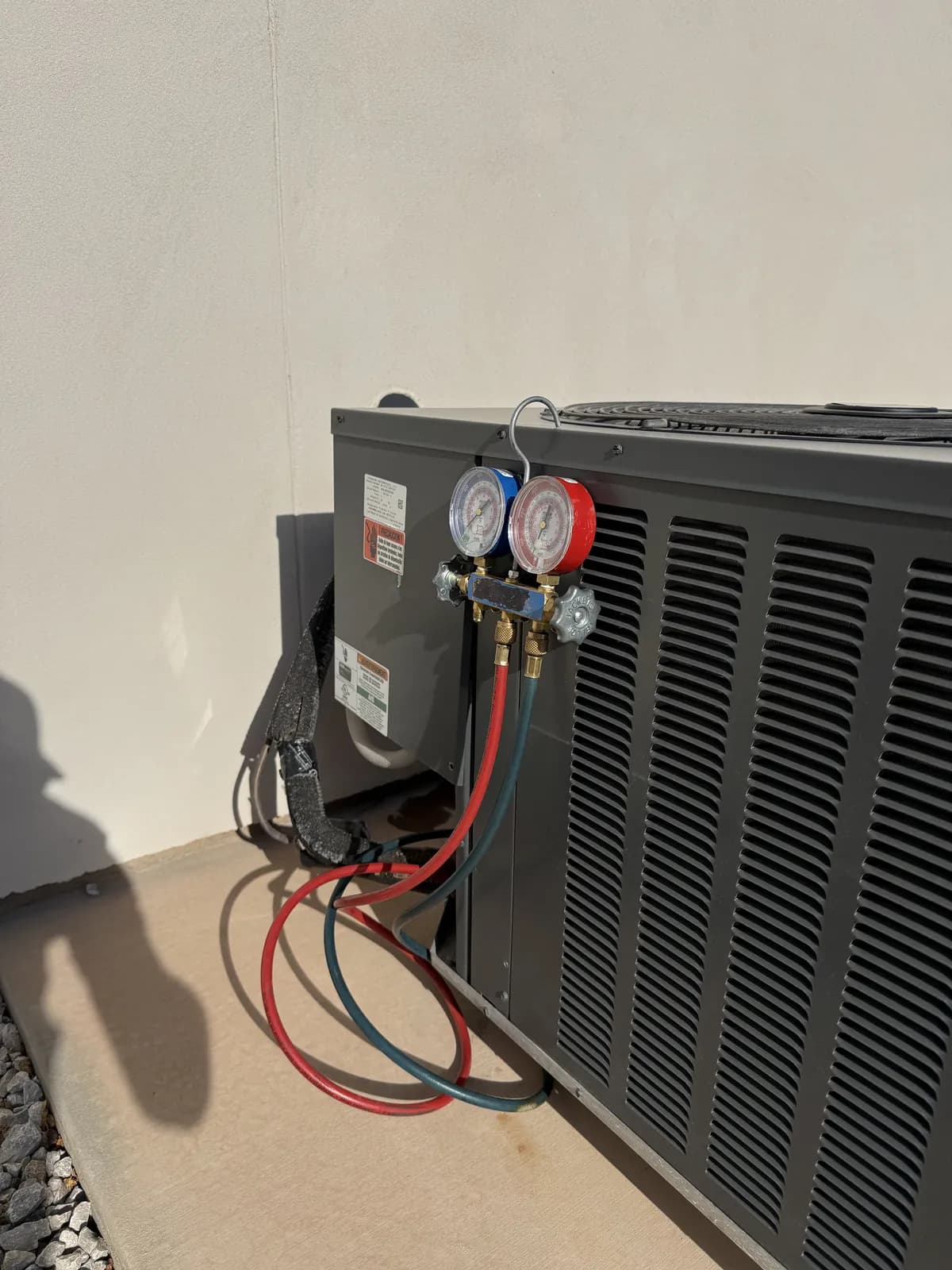
The same condenser from the side on its concrete pad against a stucco wall, the gauge set hanging from the service valves with the hoses looped below
The same call, from the side. St. George, Utah.

What the work is

A condenser rejects heat through its coil. Anything filling the fins, dust, cottonwood, grass clippings, dryer lint, means the compressor works harder for less cooling and runs hotter doing it. It is the cheapest thing that can be wrong and the most commonly ignored.

We wash the coil from the inside out so the debris comes back the way it went in, comb the fins that are bent, and check the fan and the clearances around the unit.

Why direction matters: debris enters the coil from the outside, so washing from the outside in drives it further into the fins and packs it. Washing from the inside out, with the top off and the fan lifted clear, pushes it back the way it came.

Clearance is the other half. Manufacturers publish a minimum around the unit and above it, and a condenser boxed in by a fence, a shrub or an air conditioner cover left on is recirculating its own hot discharge air. That shows up as high head pressure and a system that cannot keep up on the hottest afternoon, and it is free to fix.

What is included

  • The coil washed from the inside out, which is the direction that works
  • Bent fins combed straight
  • Fan motor and blade checked, and clearances around the unit
  • The readings before and after, so you can see whether it did anything
  • Manufacturer clearances checked and, where they are not met, told to you

What is not

  • A pressure washer on a coil, which flattens the fins and makes it worse
  • Acid coil cleaner as a routine choice

Heat rejection is the whole job

St. George recorded 98 days at or above 100°F in 2024, the most on record, with back-to-back hottest Julys in 2023 and 2024. The all-time high is 117°F.

A condenser works by dumping the heat from inside your house into the air outside it, and the hotter that outside air is, the harder that is. On the hottest afternoons here the margin is already thin, which is why a coil that is half blocked shows up as a system that cools fine in May and cannot hold temperature in July. The same coil, the same fault, and the weather is what makes it visible.

What to ask anyone quoting this, us included

  • Which direction did you wash it?
  • What did the readings do afterwards?
  • How much clearance does this unit need, and does it have it?
  • Did you take the top off to wash it?
  • Does my unit have the clearance the maker asks for?

What we can show you in writing

Every line traces to a document we read in full. The number after a sentence points to the research below.

  • EPA requires Section 608 certification for anyone who attaches and detaches hoses and gauges, or adds refrigerant to an appliance or removes it. It is issued to individuals. Ask which type the person at your condenser holds.1
  • The federal refrigerant rules exempt equipment that existed in the United States before December 27, 2020, and the restrictions run to equipment being made, imported, sold or installed. They do not reach a system already sitting on your roof.1
  • R-410A is being phased down on a published schedule, not banned. Production and consumption step down in stages to 15 percent of baseline in 2036. Price and availability are the mechanism, not prohibition.1

Where this comes from

Every line above traces to a document we read in full. The number after a sentence points to the research below; hover it for the section. If you find a line wrong, tell us and we will fix it and say so.

  1. Heating and air research, September 2026 Compiled from the Code of Federal Regulations at 10 CFR 430 and the Federal Register, EPA rules on refrigerant transition, the Utah Code and Utah DOPL's licensing records, ACCA's load calculation standard, ASHRAE and the AHRI directory, Pacific Northwest and Lawrence Berkeley National Laboratory publications, NOAA climate normals, ENERGY STAR, and the published data of Trane, Lennox and Daikin. 3 sections cited. Hover a number above for the section.

The rest of keeping it running

The quote is the number. There is no second number.

Call (435) 850-0053

7 a.m. to 5 p.m., weekdays. Emergency calls answered any hour, every day.