
St. George Home Services

Concrete coatings · The slab underneath

Failed coating removal and recoat

Taking off what is peeling, finding out why it did, and telling you the answer before we quote putting anything back. The second coating fails for the same reason the first one did unless somebody establishes what that reason was.

One flat fee to find out what is wrong. You are told it on the phone before anyone is dispatched, and it comes off the job if you hire us. Read our Plain Terms

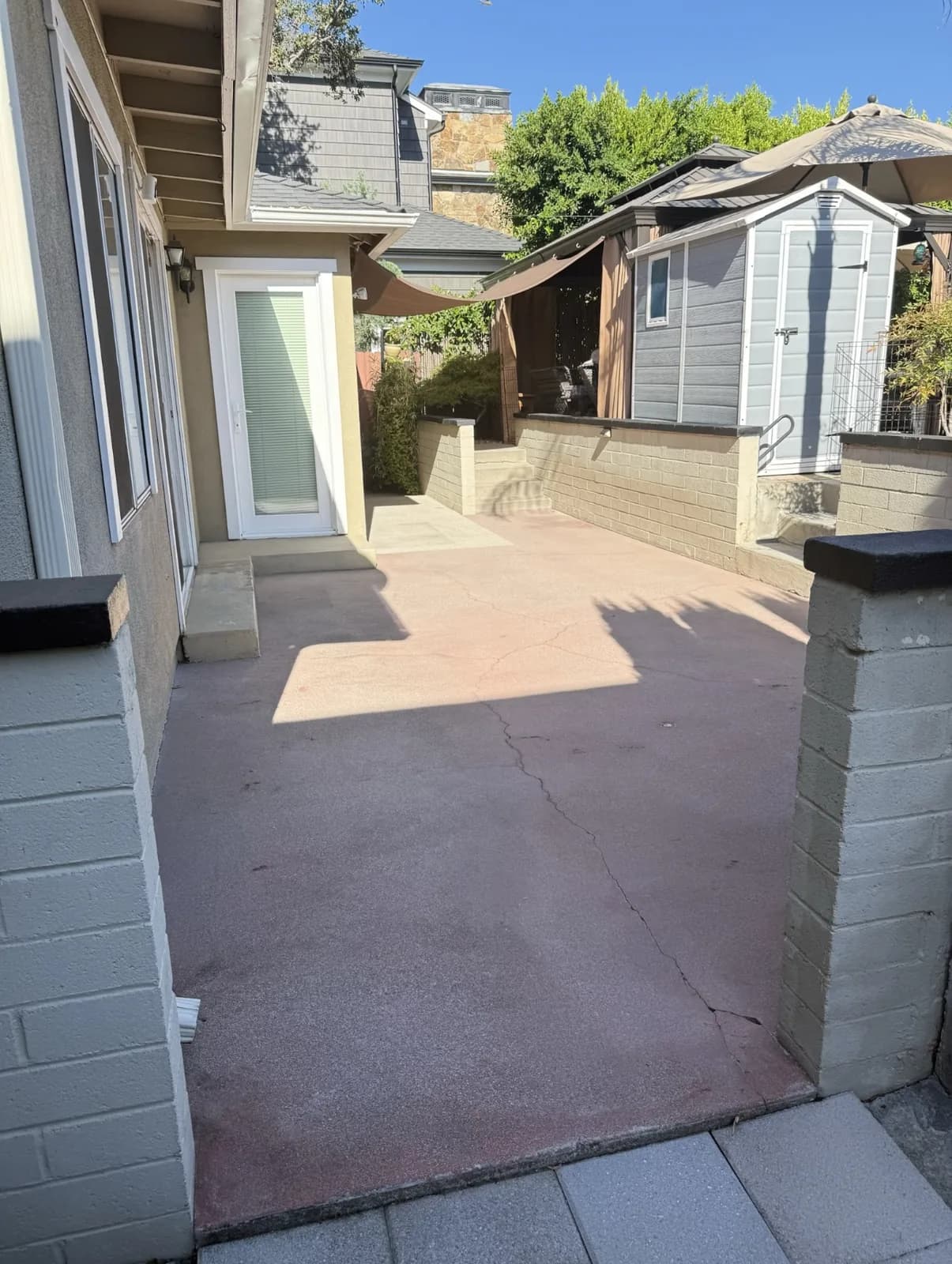
An old red-tinted concrete patio before work, faded and worn through in patches, with pale scars from earlier repairs running across it and a shed at the far end
Before, elsewhere. The pale lines are earlier repairs, not cracks in a coating.

What the work is

A failed coating is evidence. How it is failing narrows the cause considerably: a film lifting cleanly in sheets with a powdery gray underside points at laitance and inadequate preparation. Blisters, and a bond that is sound everywhere except where the blisters are, point at moisture moving up through the slab. Lifting in the tire tracks and nowhere else is a different story again.

So the first part of this job is not removal. It is looking at what is there and saying what we think happened. If the cause is moisture, then grinding it off and applying the same system again produces the same result, and you should not pay for that twice.

Removal itself is grinding, and it is slower and dustier than grinding bare concrete. A thick or well-bonded coating can cost more to take off than the new finish costs to put on, and where that is the case we will tell you before you commit.

Sometimes the honest answer is that we would not recoat this slab. We would rather say that than take the job.

What is included

  • An assessment of how the existing coating is failing, and what that indicates
  • Moisture testing before anything is quoted for the replacement
  • Mechanical removal of the failed coating
  • A written account of the likely cause, which you keep
  • A plain statement if we think the slab should not be recoated

What is not

  • Recoating without establishing why the last one failed. We will not do it
  • A removal price quoted from a photograph. We look at it first
  • Chemical stripping. This is mechanical removal

What to ask anyone quoting this, us included

  • Why did the last one fail? If nobody can tell you, that is the answer
  • Has the slab been moisture tested since it failed?
  • What is different about this system compared with the one that came off?
What we can show you in writing

Every line traces to a document we read in full. The number after a sentence points to the research below.

  • Concrete substrates must be mechanically prepared to remove cement laitance, existing coatings and curing compounds, and to achieve a profile that is clean, dry and free of dirt, grease and oil. Diamond grinders create that profile and remove high spots and coatings; shot blasting is described as the industry standard for surface preparation of concrete.1
  • ASTM F2170 measures the internal relative humidity of a slab using probes set in holes drilled to 40 per cent of the slab depth, and has been displacing calcium chloride testing as the preferred method since 2002.1
  • Bleed water trapped below a finished slab surface can cause delaminations or blisters where finishing was carried out before the bleed water had left the surface. That is a defect in the original slab rather than in anything applied over it.1

Where this comes from

Every line above traces to a document we read in full. The number after a sentence points to the research below; hover it for the section. If you find a line wrong, tell us and we will fix it and say so.

  1. Concrete coatings research, September 2026 Compiled from ICRI Guideline 310.2R-2013 on concrete surface preparation, the ASTM moisture test standards F2170, F1869 and D4263, ACI 302.2R and NRMCA CIP 29 on slabs and vapor retarders, Sika's published surface preparation guide, Sherwin-Williams product literature on polyaspartic chemistry, and the Utah Geological Survey and Utah DEQ material already cited in the environment research. 3 sections cited. Hover a number above for the section.

The rest of the slab underneath

The quote is the number. There is no second number.

Call (801) 680-6859

7 a.m. to 5 p.m., weekdays. Emergency calls answered any hour, every day.