
Permanent lighting is booking now for the holidays.

See permanent lighting
St. George Home Services

Heating and air · Ducts, controls and air

Air filtration and air handling

Filtration sized so it cleans the air without starving the blower.

One flat fee to find out what is wrong. You are told it on the phone before anyone is dispatched, and it comes off the job if you hire us. Read our Plain Terms

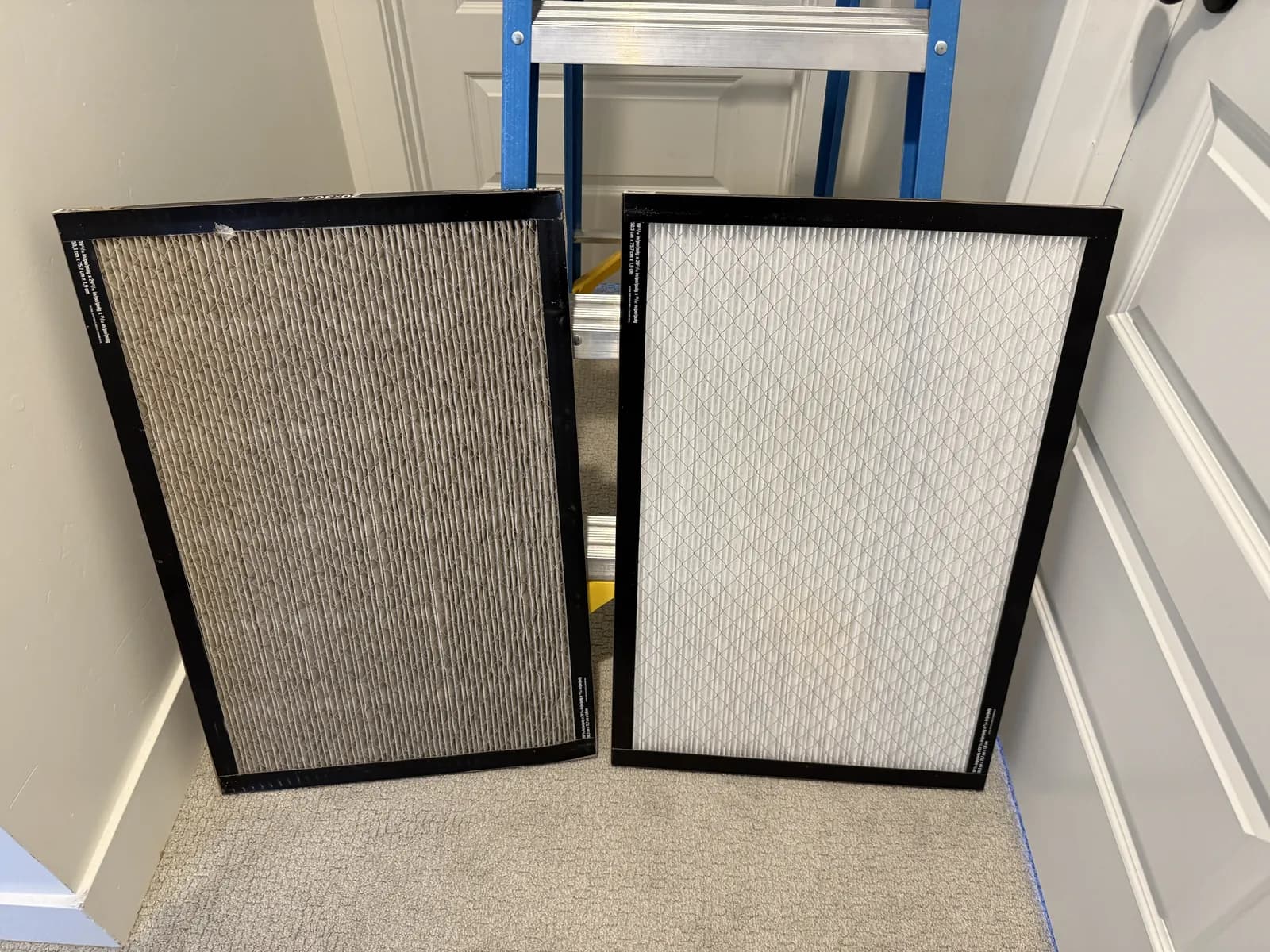
Two furnace filters standing side by side on a hallway floor: the one on the left grey and loaded with dust across its pleats, the one on the right new and white
The filter that came out, beside the one that went in. St. George, Utah.

What the work is

A denser filter in a housing built for a thinner one restricts airflow, and restricted airflow is the cause of a long list of expensive symptoms: a furnace tripping its limit, a coil freezing, a compressor working against itself. The filter that promises the most is not automatically the right one.

The fix is filter area, not filter density. A deeper media cabinet gives you better filtration and less restriction at the same time, and it is the change worth making if anyone in the house has a reason to care about what is in the air.

The number to know is total external static pressure, measured across the system. Most residential equipment is rated to about half an inch of water column and a great deal of it in the field is running well above that, mostly because of filters and undersized returns. Above the rating the blower moves less air, the coil runs colder, and the equipment works harder for less.

So we measure before and after. If a filter you want cannot be carried by the system as it stands, the answer is usually more filter area rather than a thinner filter — a deeper cabinet, or a second return — and we will quote that rather than tell you to buy something worse.

What is included

  • The static pressure measured before and after, so the effect is a number rather than an opinion
  • A filter housing sized to the system's airflow
  • What to buy next time, written down, so nobody has to guess in an aisle
  • Total external static pressure measured across the system, before and after

What is not

  • A filter rating the equipment cannot carry
  • Claims about health outcomes. We move air; we are not going to tell you what it will do for anyone's asthma

What to ask anyone quoting this, us included

  • What is the static pressure now, and what should it be?
  • Will this filter restrict my airflow?
  • What size and rating do I buy next time?
  • What is my static pressure, and what is the equipment rated for?
  • Is the fix a different filter or more return?

What we can show you in writing

Every line traces to a document we read in full. The number after a sentence points to the research below.

  • MERV stands for Minimum Efficiency Reporting Value. It reports a filter's ability to capture particles between 0.3 and 10 microns, on a test method developed by ASHRAE.1
  • EPA recommends a filter of at least MERV 13, or as high a rating as the system fan and filter slot will take, and says most furnaces and HVAC systems can accommodate a MERV 13 filter without equipment problems provided it is replaced frequently.1
  • A high MERV number does not automatically mean a high pressure drop. Filters with deeper pleats, or more of them, tend to have lower pressure drop — four-inch-deep pleats carry twice the surface area of two-inch pleats. Depth matters more than the number on the box.1
  • Lawrence Berkeley National Laboratory monitored ten homes for a year with filters from MERV 6 to MERV 16. At MERV 10 to 13 the effect on energy use was under 1 percent. MERV 16 was where the trouble started, over 5 percent and usability problems with it.1

Where this comes from

Every line above traces to a document we read in full. The number after a sentence points to the research below; hover it for the section. If you find a line wrong, tell us and we will fix it and say so.

  1. Heating and air research, September 2026 Compiled from the Code of Federal Regulations at 10 CFR 430 and the Federal Register, EPA rules on refrigerant transition, the Utah Code and Utah DOPL's licensing records, ACCA's load calculation standard, ASHRAE and the AHRI directory, Pacific Northwest and Lawrence Berkeley National Laboratory publications, NOAA climate normals, ENERGY STAR, and the published data of Trane, Lennox and Daikin. 2 sections cited. Hover a number above for the section.

The rest of ducts, controls and air

The quote is the number. There is no second number.

Call (435) 850-0053

7 a.m. to 5 p.m., weekdays. Emergency calls answered any hour, every day.