
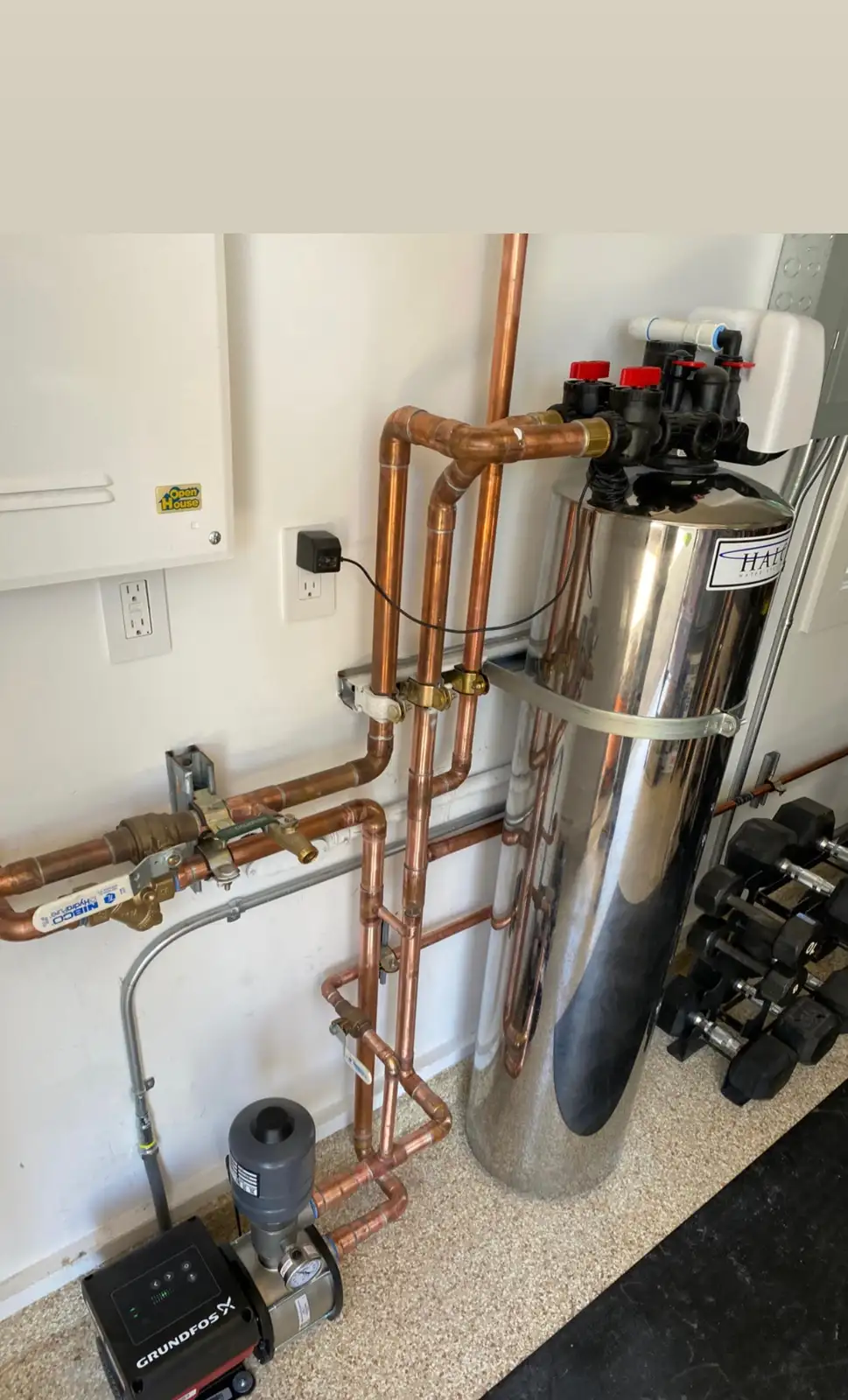
What the work is
A salt-free conditioner does not remove calcium and magnesium. It changes their form so they are less likely to plate onto surfaces. Total hardness at the tap is unchanged, and a hardness test after one will read the same as before.
That matters because manufacturers write their limits as total hardness. On our reading, a conditioner does not bring an 18-grain house under a 200 mg/L limit. That is our reading of the documents and not a manufacturer's ruling, and if you are relying on it for a warranty you should confirm it with the maker of your unit in writing.
What a conditioner does do is add no chloride to the sewer, use no salt, and need no drain. In some situations that is worth a lot. We would rather you chose one knowing all three things.
What is included
- The unit, installed with a bypass
- A written statement of what your hardness is before and after
- Plain advice on whether it suits what you are trying to protect
What is not
- Any claim that it softens water. It does not, and we will not write that down
- Any claim that it satisfies a manufacturer's hardness limit
- Drinking water treatment
When we would still recommend one
Where a drain or a salt supply is genuinely impractical, where the household wants no added sodium, or where the goal is scale on fixtures rather than a warranty condition on a tankless heater. Those are real cases and we install for them.
Where the goal is protecting a tankless heat exchanger and keeping the warranty intact, a softener is the answer and we will say so even though the conditioner is an easier sale.
What to ask anyone quoting this, us included
- Will my hardness test lower after this is installed?
- Does the maker of my water heater accept this as treatment?
- What am I actually trying to protect?