
St. George Home Services

Painting · Inside the house

Trim, doors and baseboards

Baseboards, casing, doors and handrails. The parts of a room people actually touch, on their own or with the walls.

One flat fee to find out what is wrong. You are told it on the phone before anyone is dispatched, and it comes off the job if you hire us. Read our Plain Terms

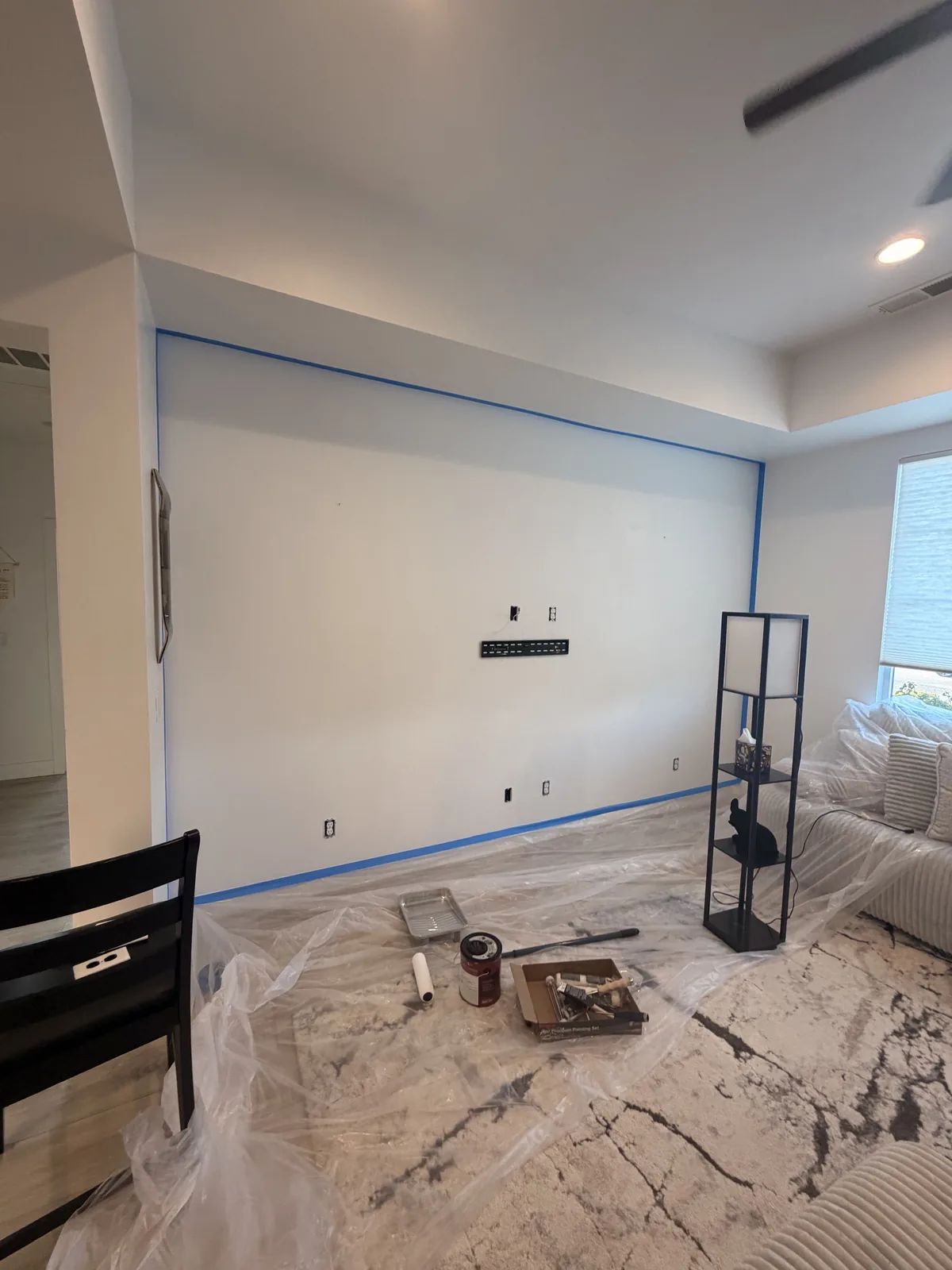
The same room with the furniture pulled back and covered, the floor sheeted, and blue tape run along the edges of the wall to be painted
Masked and sheeted, before a can is opened. St. George, Utah.

What the work is

Trim gets dirty in a way walls do not, because hands and feet and vacuum cleaners meet it. It is also the part of a room where a bad job is visible from across the space: a run of baseboard shows every drip and every missed sanding mark along its top edge.

The work is filling nail holes and split joints, sanding what was glossy, and caulking the line where trim meets wall so the two read as one surface. On doors, the hardware comes off rather than being masked, and the door is painted in the order that lets the edges dry without sticking.

Old trim that has been painted a dozen times has a thick, soft build-up that chips to bare wood at the corners. On those, sanding back the ridges matters more than another coat, and we will tell you when a piece is better replaced than painted.

Interior doors are the same job at a different scale. A door that is painted while closed sticks; a door painted on both faces on the same day in dry air can be back in service quickly, and we plan around which doors you need to shut that night.

What is included

  • Nail holes and open joints filled and sanded
  • Glossy surfaces deglossed so the new coat can hold
  • The wall-to-trim caulk line cut out where it has split, and replaced
  • Door hardware removed and reinstalled
  • Edges and tops sanded smooth, not just coated

What is not

  • Replacing rotten or damaged trim, which we will quote separately
  • Stripping trim back to bare wood, which is its own job and a large one
  • Refinishing stained woodwork clear. That is a different trade and we do not pretend otherwise

What is different here

Most trim in this county is newer than people assume. Of 88,415 housing units, 91% were built in 1980 or later, which means factory-primed and factory-finished material rather than decades of brush coats over old growth wood. It takes paint predictably, and it does not hide a lead question.

Where the house is older, it does. Homes built before 1978 come under the federal lead rule, and sanding painted trim is exactly the kind of disturbance the rule covers. On a house of that age we ask before we sand, not after.

What to ask anyone quoting this, us included

  • Are you filling and sanding the nail holes, or just painting over them?
  • Is the hardware coming off the doors?
  • What are you doing about the caulk line where the trim meets the wall?
  • Which doors will I be able to close that night?

What we can show you in writing

Every line traces to a document we read in full. The number after a sentence points to the research below.

  • Sherwin-Williams states it on its own product data sheet: most coating failures are due to inadequate surface preparation or application. It also warns that any surface preparation short of total removal of the old coating may compromise how long the system lasts.1
  • Federal law treats homes built before 1978 differently. Under the EPA's Renovation, Repair and Painting rule, work that disturbs more than 6 square feet of painted surface in a room inside, or 20 square feet outside, must follow the rule's work practices — and sanding or scraping paint counts as disturbance. Window replacement counts at any size.1
  • The USDA Forest Products Laboratory puts it in four words in its own surface preparation guidance: do not sand lead-based paint.1
  • Washington County's housing stock is young: of 88,415 units, 7,613 were built before 1980 and 91% went up in 1980 or later, on the Census Bureau's American Community Survey. What that means in a room is that most walls and trim here are factory-finished and machine-textured rather than hand-worked.1

Where this comes from

Every line above traces to a document we read in full. The number after a sentence points to the research below; hover it for the section. If you find a line wrong, tell us and we will fix it and say so.

  1. Painting research, September 2026 Compiled from Utah DOPL's contractor classification list and Utah Code § 58-55-305, the EPA's Renovation, Repair and Painting rule at 40 CFR Part 745 Subpart E, the USDA Forest Products Laboratory's Wood Handbook chapter on finishing, EPA's asbestos guidance, and the published technical data sheets of Sherwin-Williams, Benjamin Moore, PPG and Dunn-Edwards. 4 sections cited. Hover a number above for the section.

The rest of inside the house

The quote is the number. There is no second number.

Call (801) 680-6859

7 a.m. to 5 p.m., weekdays. Emergency calls answered any hour, every day.