
St. George and Washington County
Permanent lighting. Put it up once.


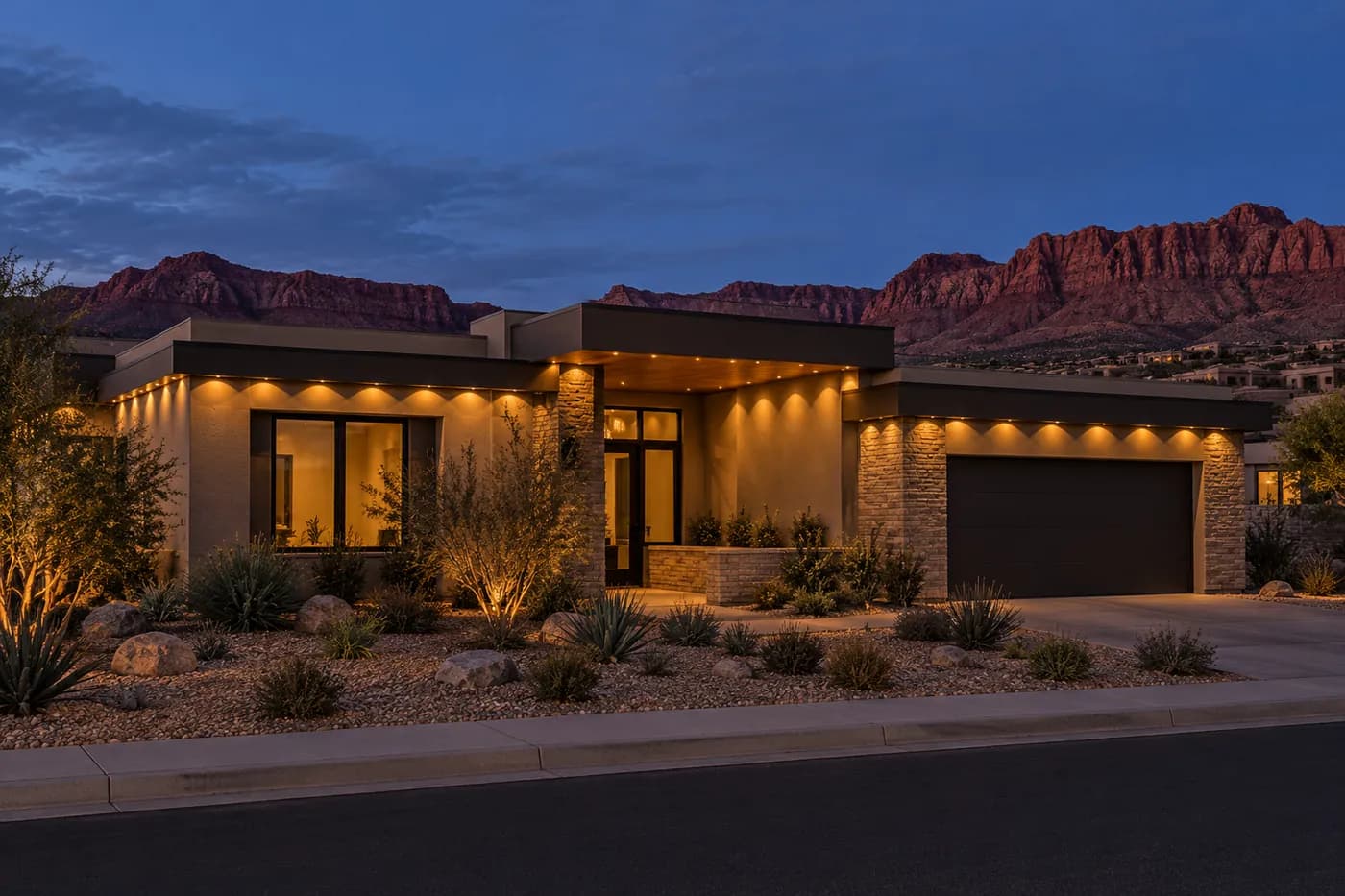
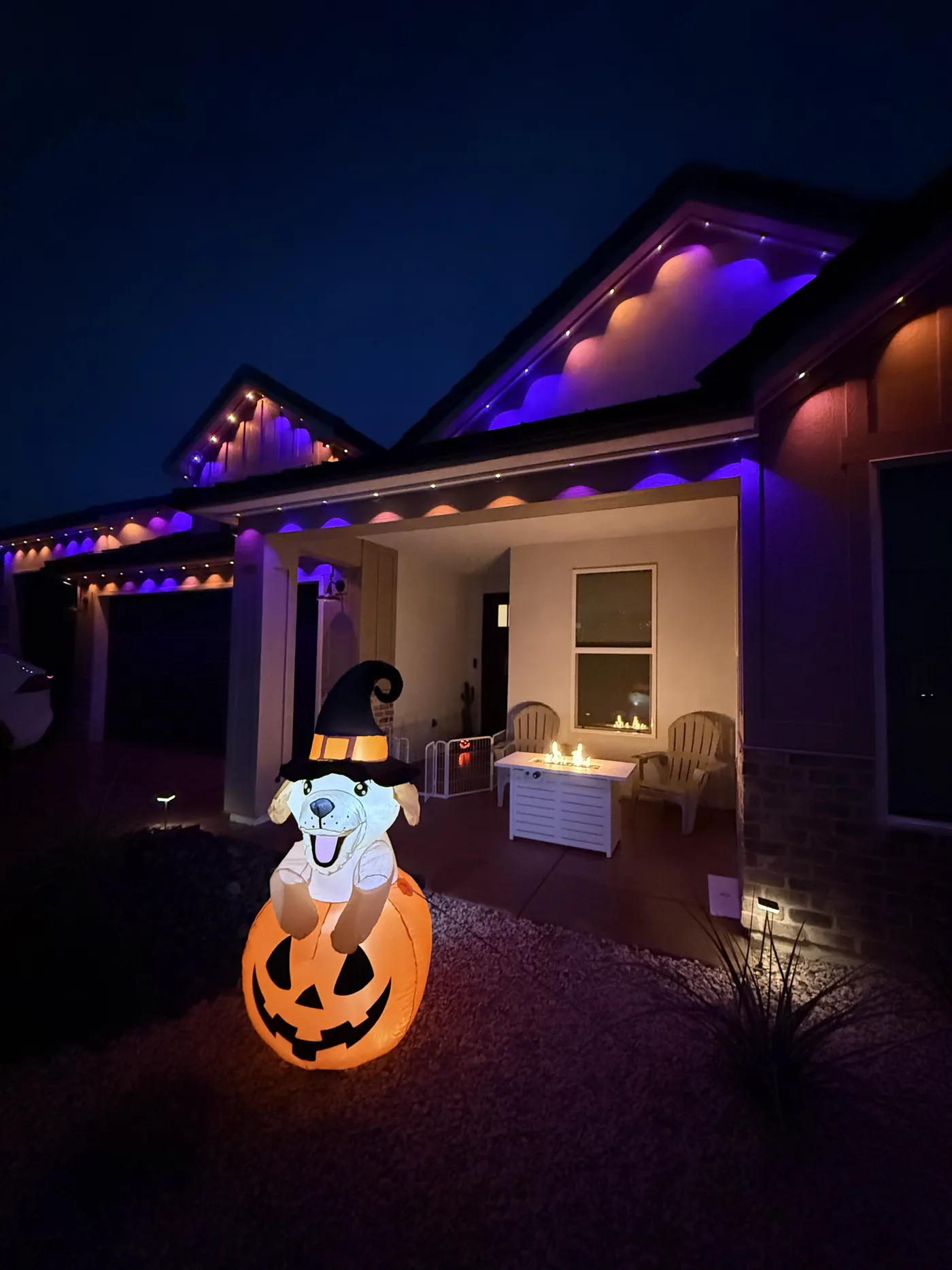
Permanent lighting runs in a small track tucked under the eaves, and it stays up all year. Warm white on an ordinary night. Orange and purple in October. Whatever you like in December. You change it with a remote, not a ladder.
Want it up for the holidays? Ask now. You get the install date and the whole price before you agree to anything. Read our Plain Terms
Three houses, filmed the same night.
No sound on any of them. Each one is described underneath, so you know what it shows before you press play.
Warm white, from the driveway to the back porch
The everyday setting. One house, walked from the front gable past the garage to the covered back porch. Each light throws a soft scallop down the siding, and the porch ceiling and posts are lit without a fixture on them. 26 seconds.
Front door and down the side of the house
A second house. From the front door, around the corner and along the side wall to the back. The lights sit tight under the eave; what you see is the wall they light, not the lights. 20 seconds.
What goes up, in daylight
A third house, during the install. A thin white track is fed along and pressed up into place under the eave, one length at a time. Once it is up, it follows the line of the roof. 27 seconds.
All three are customers’ houses in Washington County, Utah, filmed October 17, 2026.
What the remote changes
Everything on it is adjustable. That is how it follows the rules.
Three towns here have rules about lights on a house, and all three are about things this system lets you change. So it is set to your town before we leave, and you are shown how to change it.
- Color
- Any color you like, one color or several along the run, or warm white.
- How warm the white is
- Set in Kelvin, so it can sit at or under your town’s limit: 3,000K in Ivins, 2,700K on new construction in Toquerville.
- Brightness
- Turned down for an ordinary night, up for a party.
- Steady or moving
- Patterns that chase or twinkle are there for a holiday. Ivins, Toquerville and La Verkin prohibit moving light outside holiday lighting, so the everyday setting there is steady.
- When it is on
- On and off at the times you set. Toquerville turns holiday lights off from 11 p.m. to 6 a.m., and a schedule does that without anyone remembering.
The section for each town’s rule is in Before it goes up: your town, further down this page.
One install, twelve months
A year on the same roofline
Nothing comes down between any of these. Each one is a setting you choose from the remote, and you can save the ones you like.
- Most nightsWarm white, steady
- JanuaryCool white and icy blue
- FebruaryRed and pink
- SpringSoft pastels
- JulyRed, white and blue
- Football seasonYour team's colors
- OctoberOrange and purple
- DecemberRed and green, or all white
How it goes
Call, or send a message
Tell us the town and whether there is an HOA. Those two answers decide what the everyday setting can be.
We measure and quote
Which rooflines, how many feet, where it plugs in. You get one number for the whole job, and that is the number you pay.
It goes up
The track under the eaves, then the lights, the power supply and the controller.
It is set to your town
Before we leave, the everyday setting meets your town’s rule, and you are shown the remote and how to save your own settings.
Call (435) 850-0053
7 a.m. to 5 p.m., weekdays.
Why people leave it up
It looks like part of the house
Most nights it is warm white, and what you notice is the roofline, not a string of lights. The track sits tight under the eave and follows it.
When you want color, it is there: a holiday, October, a birthday, a team’s game. Then it goes back to white, and nothing has to come down.
The house is lit
The driveway, the porch and the walk to the door are lit when you get home after dark. You can see the step. So can whoever is coming to the door.
And nobody goes up a ladder every November to hang strings and every January to take them down again.
What the job is
Included
- Measuring the rooflines you want lit, and quoting the whole run as one number
- The track, mounted under the eaves along those runs
- The lights, the power supply and the controller
- Setting up the remote with you before we leave
Not included
- A new outdoor outlet or circuit. If there is no power where the run needs it, that is our licensed electrical partner’s work, quoted separately before anything starts.
- Repairs to fascia or soffit. If the wood we would mount to is damaged, you hear about it before anything is fastened to it.
Path and garden lighting, too
The same page covers the ground: low-voltage path, step and uplighting on a transformer and a timer. Good landscape lighting is aiming and restraint: fewer fittings, aimed carefully, at a lower level than most people expect. The failure is glare, fittings you look at instead of the thing they light. It is aimed after dark, because that is the only time aiming can be done properly.
Before it goes up: your town
Most towns here do not regulate lights on a house. Three do, and the rules are about color, movement and late hours, which is exactly what this system can change. So here is what each one says, with the section, before you choose a setting.
- Ivins
- The lighting chapter applies to every single-family home (§ 16.23.108(1)). Outdoor lamps on a house must be 3,000 Kelvin or warmer (§ 16.23.105(3)(b)). Lights that flash, blink or seem to move are prohibited, but “Holiday lighting is permitted” (§ 16.23.105(22)(b)); the code gives no dates. It also requires outdoor lighting to be fully shielded (§ 16.23.105(5)). Whether eave lights meet that is the city’s call, so ask the city before you buy.
- Toquerville
- 2,700 Kelvin is mandatory on new construction (§ 10-24-4(A)(5)). Holiday lights are turned off from 11 p.m. to 6 a.m. (§ 10-24-4(B)(3)). Moving or blinking light is prohibited, holiday lighting excepted (§ 10-24-4(D)(7)(b)).
- La Verkin
- Flashing, blinking or moving light is prohibited (§ 4-7-4(F)(3)), and holiday lighting is exempt from the chapter (§ 4-7-4(G)(1)). No color limit.
- St. George
- The outdoor lighting chapter excludes detached single-family homes (§ 10-14-1(A)). A townhome or a commercial building is a different question.
- Washington, Santa Clara, Cedar City
- We read each city’s code and found no lighting rule that reaches a house.
Codes as published on October 17, 2026. In Hurricane, ask the city: its lighting section’s reach to a single-family home is not clear from its own text.
And your HOA
A house in an HOA
Utah law says an association rule may not stop you displaying a holiday decoration on your lot or the outside of your house. It also lets the association set a “reasonable time, place, and manner restriction” on anything visible from outside: which months, which hours, which colors.
That protection does not reach a house whose outside the association maintains, which is common in townhome communities. And the law does not say whether lights left on warm white in July count as a holiday decoration at all. Read your association’s rules before you choose colors or a schedule. Utah Code § 57-8a-218(3).
A condominium
For condos the state’s protection stops at the inside of the unit. The eaves of a condo building are usually common area, so the association decides, not the owner. Ask them first. Utah Code § 57-8-8.1(6).
The night sky
DarkSky International suggests mounting roofline lights under the eaves, choosing warm tones and turning them off at a reasonable hour. Under the eaves is where these go, and warm white is the everyday setting.
What people ask before they buy
Can you see it during the day?
Yes. You see a thin track along the underside of the eave, which is what the daylight clip above shows. Anyone who tells you it is invisible is selling, not describing. What it is not is a string of bulbs and clips on your gutter.
Does it go through the roof?
No. It mounts under the eave, not on the roof covering, so nothing goes through shingles or tile. That is also why a tile roof is not a problem: the track never touches the tile.
What about stucco?
The second clip above is a stucco house. The track goes on the eave; the stucco below it is the wall it lights.
Is this what people call permanent Christmas lights?
Same product. The difference is what it does the other ten months: most nights it runs warm white, and it never comes down.
Do I need an electrician?
Usually not for the lights. Utah’s definition of electrical work excludes “work involving class two or class three power-limited circuits as defined in the National Electrical Code,” and that is what a listed Class 2 power supply is (Utah Code § 58-55-102(18)(b)(v); the same words move to § 58-55-301(2)(b)(v) on January 1, 2027). If there is no outdoor outlet where the run needs one, adding it is electrical work, and our licensed electrical partner does it.
How long do the lights last?
Every brand prints an hour figure, and they are not comparable: one local seller prints two different ones on the same page. The figure is about the LEDs, not the power supply or the controller, which are what usually stop a system. Compare the warranty instead: how many years, on which parts, and who comes out to honor it.
What does it cost to run?
Arithmetic, not a promise. Ask for the system’s wattage. Watts, divided by 1,000, times the hours it is on each night, times 365, times the rate on your power bill, is the year. Turning the brightness down and setting a schedule both lower it.
How is it priced?
By the house: how many feet of roofline you want lit, how many stories, how many corners and gables, how many separately controlled zones, and whether an outlet has to be added. You get one number for all of it, and that is the number you pay.
Will it make the house safer?
It makes the walk to the door, the step and the driveway easier to see at night, and that is all we will claim. The studies that print a crime figure are about street lighting, not a house’s eaves, and the Justice Department’s own guide on home burglary calls lighting’s effect “highly context-specific.”
What we can show you in writing
Every line traces to a document we read in full. The number after a sentence points to the research below.
- Rodents are the quiet failure mode for outdoor wiring. University of Arizona Extension records roof rats gnawing electrical wiring as a fire hazard, and they travel along wires, rafters and rooftops at night.1
- Palms are part of that problem. Roof rats nest in the crowns of palm trees, especially where old fronds have not been removed, which puts them directly above the fixtures and the wire runs most people light a palm with.1
- Sun does not usually destroy the plastic body of a fitting. It hardens and cracks the gaskets, seals and flexible parts, and that is where outdoor equipment actually fails. On PVC the surface discoloration reaches only about 0.002 inches deep.1
Where this comes from
Every line above traces to a document we read in full. The number after a sentence points to the research below; hover it for the section. If you find a line wrong, tell us and we will fix it and say so.
- Environment, water and ground research, August 2026 Compiled from the cities' own water quality reports, Utah Geological Survey Special Study 127, the Utah State Hazard Mitigation Plan, Washington County GIS hazard layers, NOAA climate records, EPA radon zones and Census QuickFacts. 2 sections cited. Hover a number above for the section.
What to ask anyone quoting this, us included
- What is the track made of, and what is it fastened to?
- If one light fails, is it replaced on its own, or the whole run?
- What warranty comes with the lights and the controller, and who honors it?
- If it stops working in year four, who comes out: you, or a dealer who may not be here?
- Does the warm white setting meet my town’s color limit?
- Where does it plug in, and is that outlet GFCI-protected?
- Is the power supply listed Class 2, or just low voltage? They are not the same thing.
Up once. Changed from the remote.
Call (435) 850-0053
7 a.m. to 5 p.m., weekdays.