
Where we work · St. George, Utah
Plumbing, accessible living and water-wise landscape in St. George.
What follows is only what is true of St. George: the water, the city's rules, the ground and the associations. 121 checkable facts, each with its source.
Same crew, same rate card, in every town we cover. Read our Plain Terms
What we do in St. George
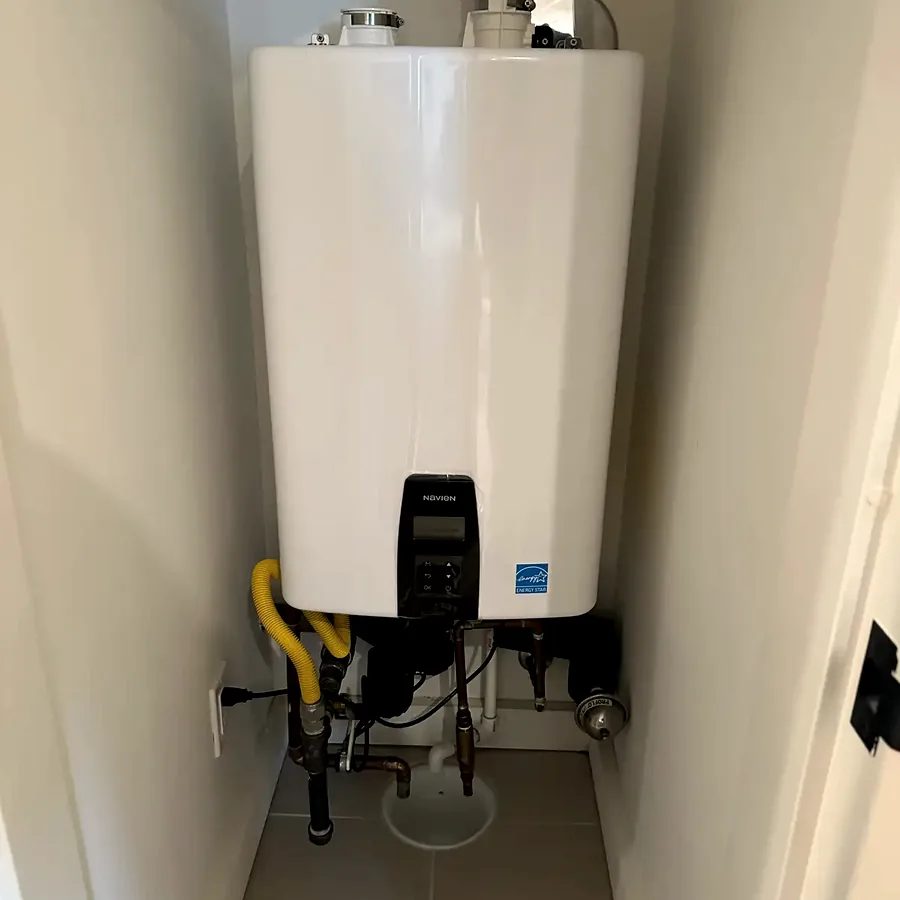
Plumbing
The systems that make the house work, and the bath and kitchen work that touches them.
- Water heaters and tankless
- Softeners and filtration
- Drains and sewer lines
- Leak detection and repipes
- Bath and kitchen work
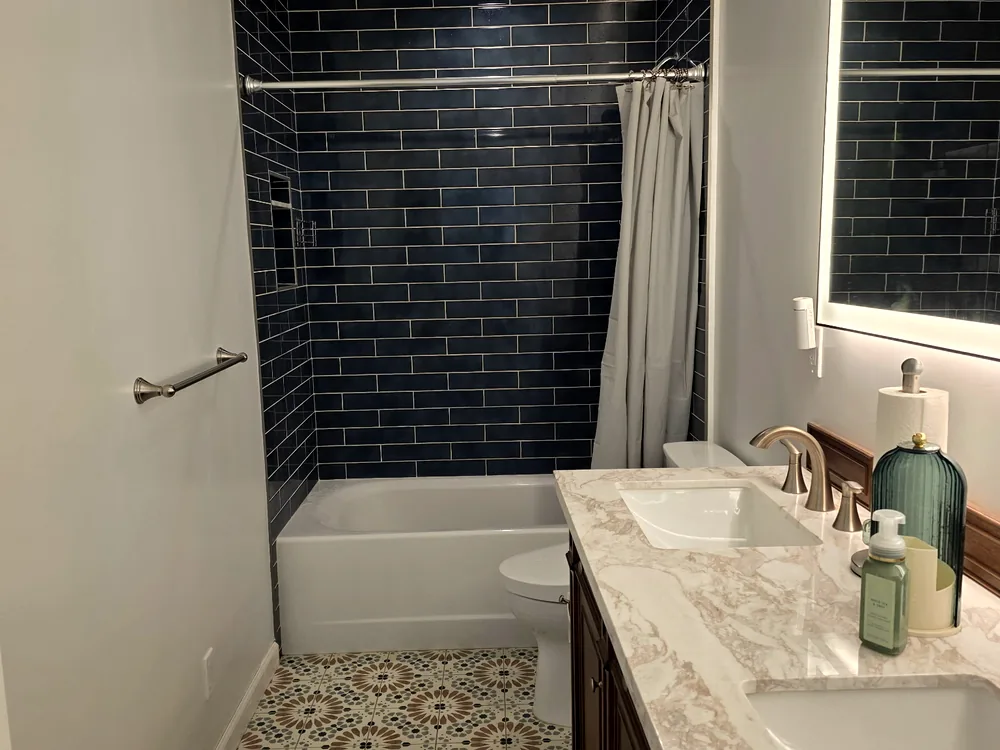
Accessible living
Built so you can stay in the house. Built so it doesn’t look built.
- Grab bars with wall blocking
- Curbless showers
- Walk-in tubs
- Doorway widening
- Home accessibility assessment
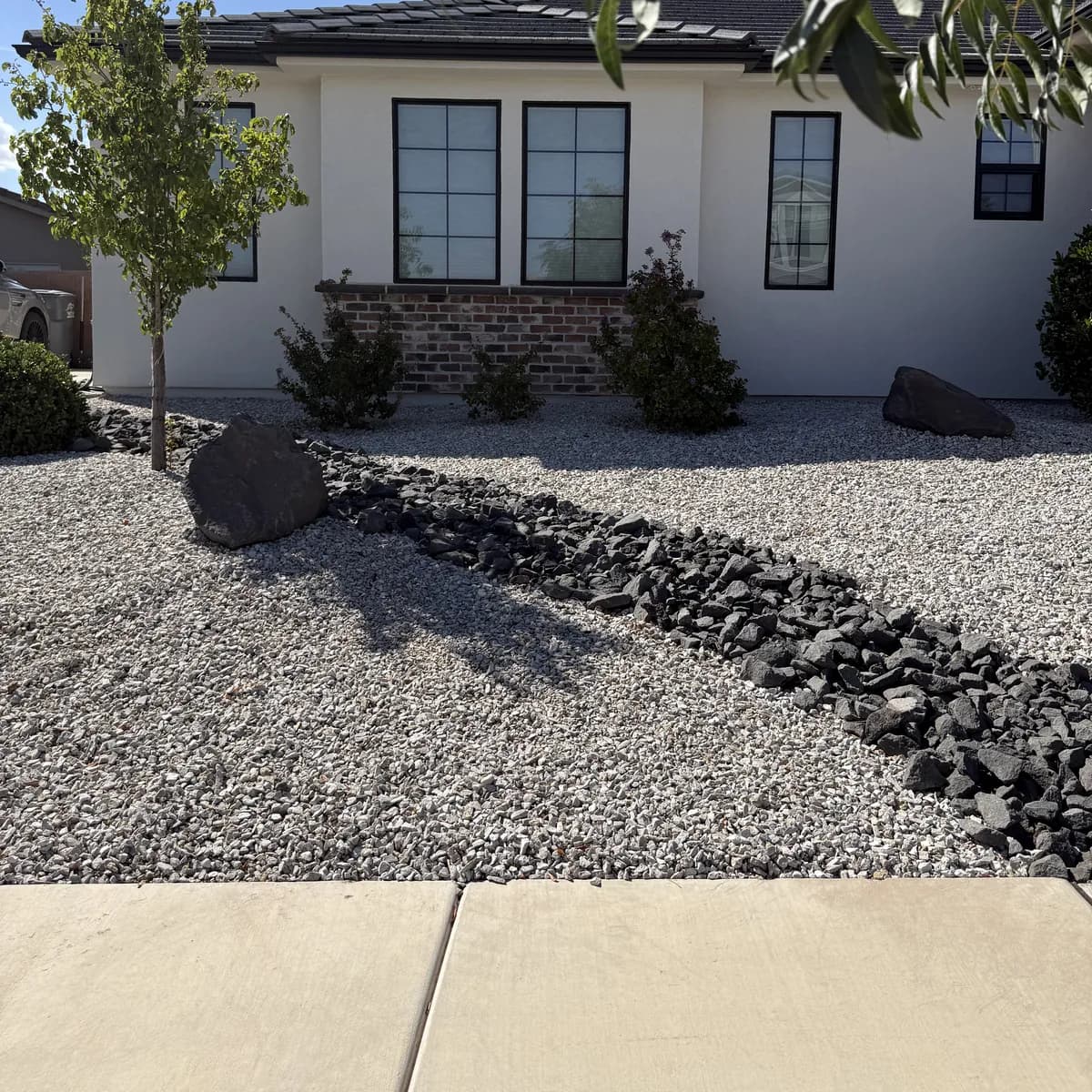
Water-wise landscape
Lawn out, desert in, with the rebate paperwork handled for you.
- Lawn removal
- Drip irrigation
- Desert planting
- Washington County rebate paperwork
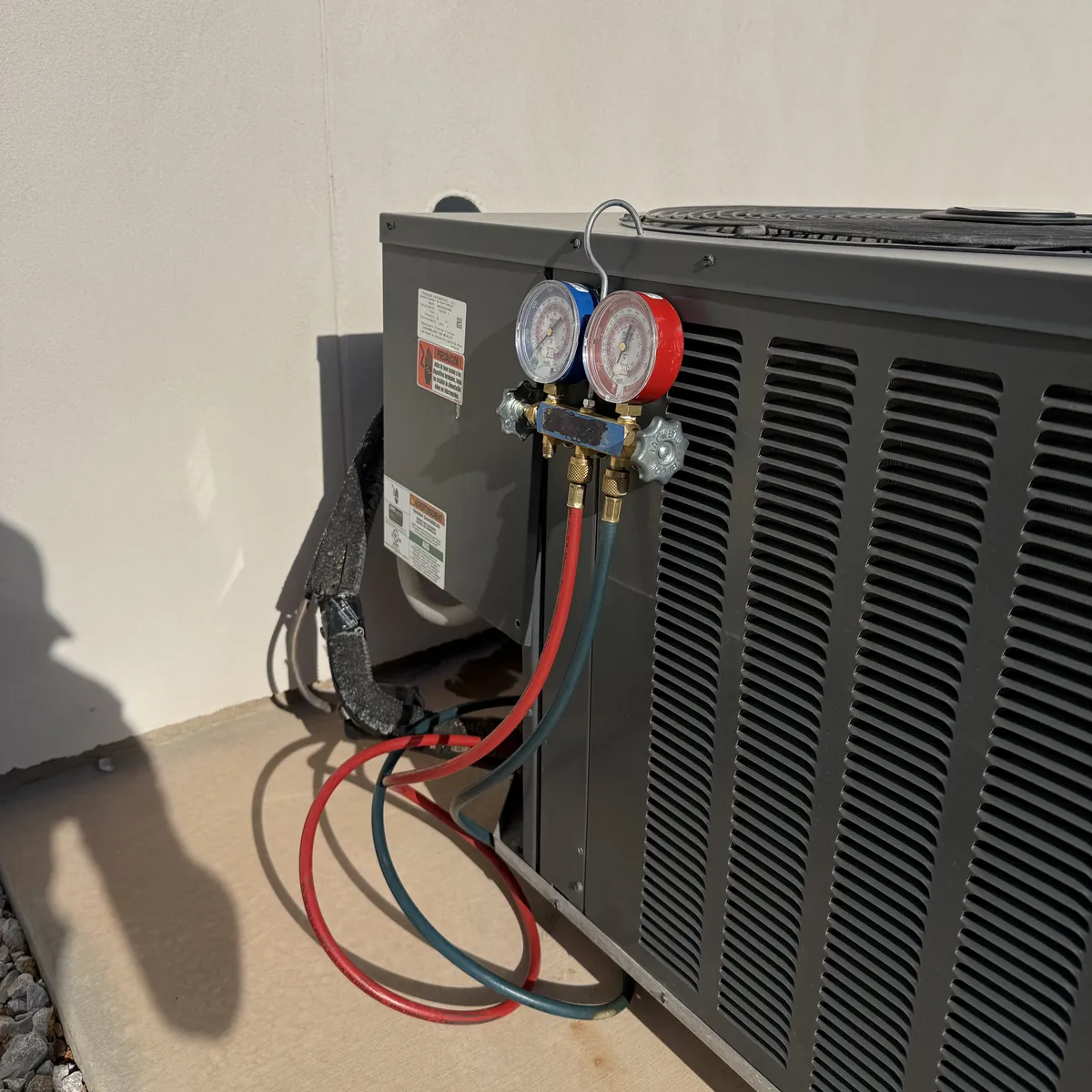
Heating and air
The system that keeps the house liveable in July, and the one thing in it you cannot put off.
- Emergency repair, any hour
- Air conditioning repair and replacement
- Furnaces, heat pumps and mini-splits
- Duct sealing and system sizing
- Tune-ups with the readings written down
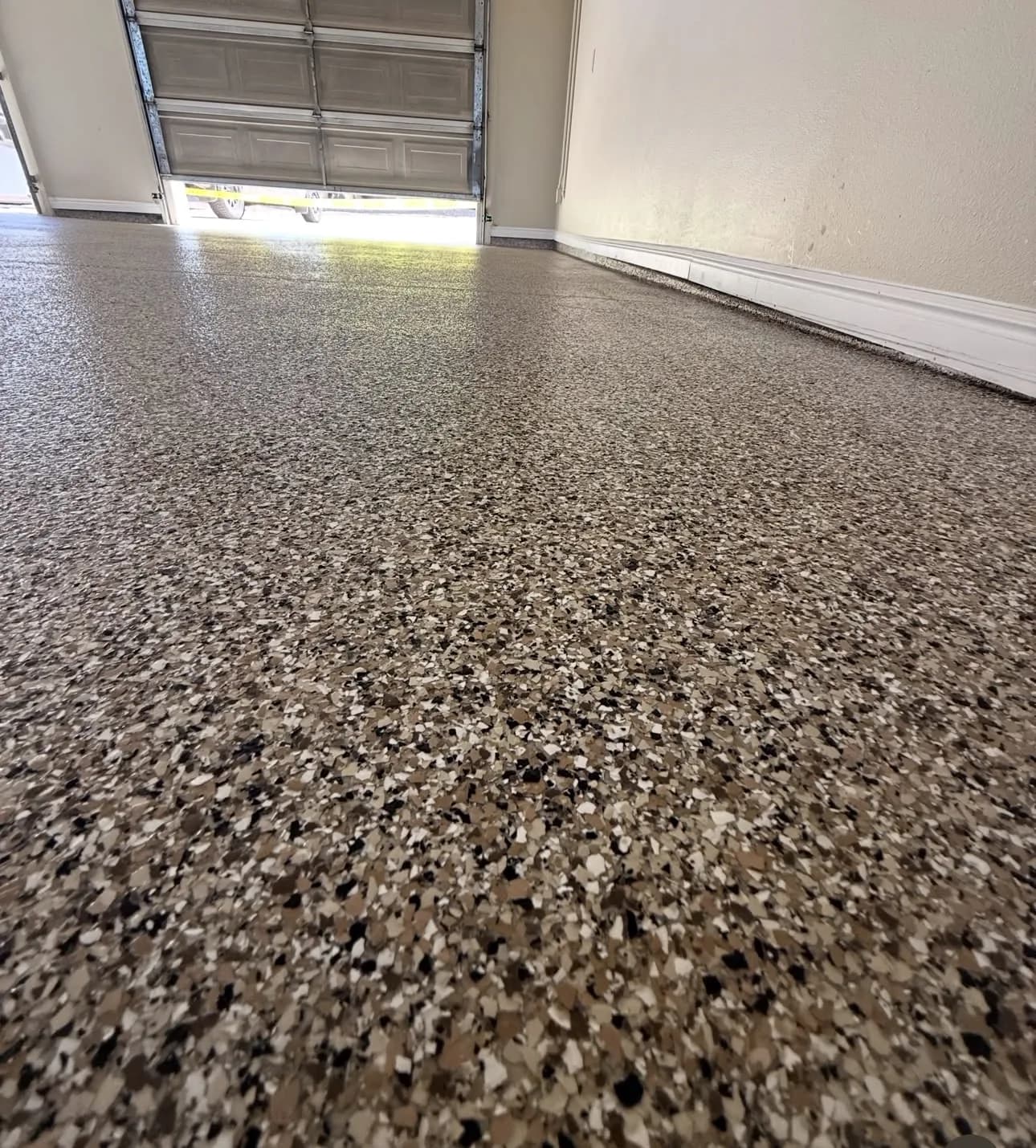
Concrete coatings
The floor you already own, ground back and finished. Garages, patios, driveways and shop floors.
- Garage floors, flake and solid color
- Driveways, patios and pool decks
- Basements and interior slabs
- Warehouse and shop floors
- The slab tested before anything is quoted
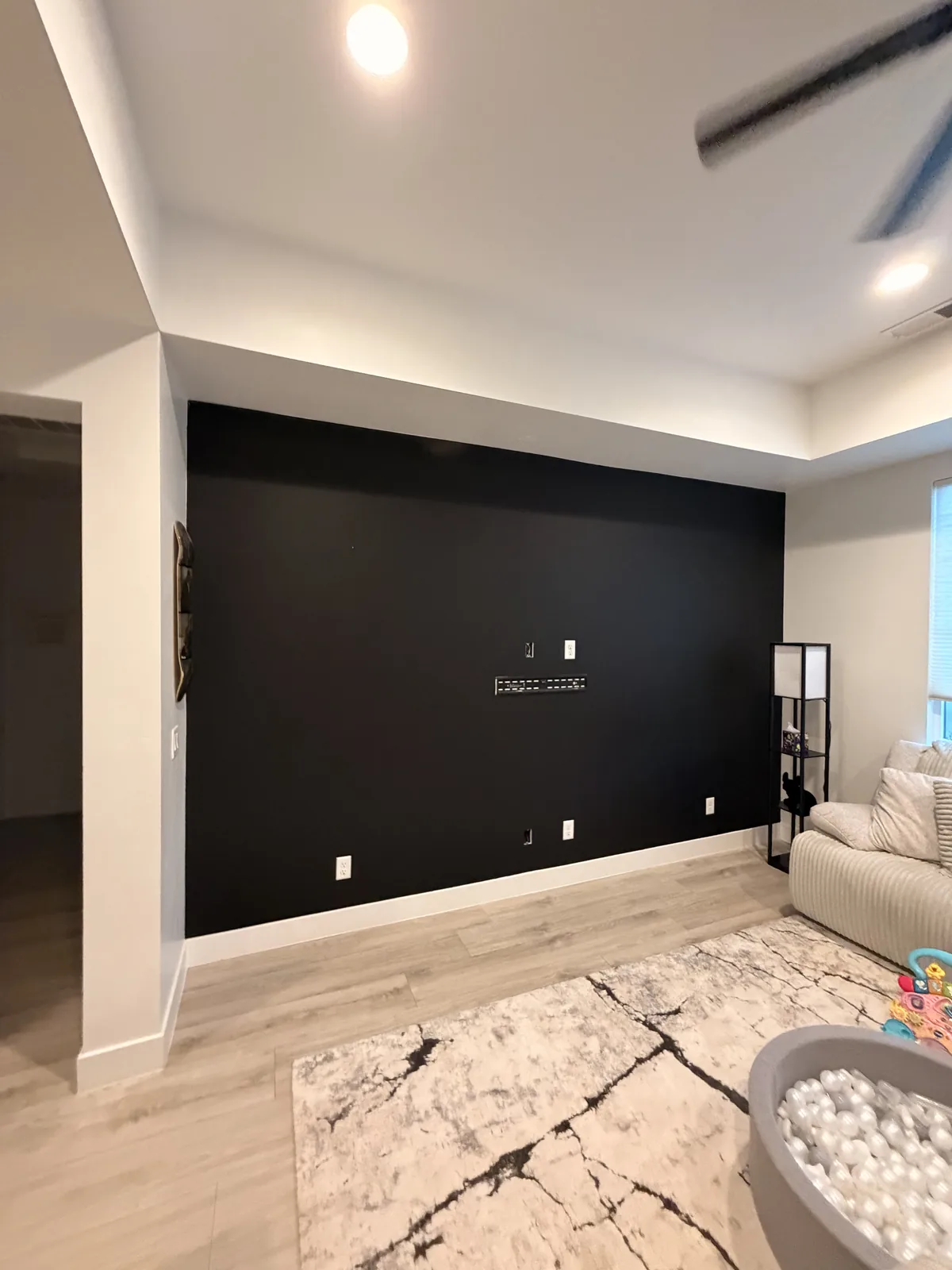
Painting
Inside, outside, and the wall repair that has to happen before either one.
- Interior walls, ceilings and trim
- Exterior repaints, including stucco
- Kitchen and bath cabinets
- Drywall repair and texture matching
- Popcorn ceiling removal
St. George, in detail
121 things that are true here, each with its source.
Read the part you came for. Every line traces to a document we read in full, numbered in where this comes from.
The water
What comes out of the tap here, and what it does to a water heater.
- The City of St. George's Water Distribution Division instructs residents to set water softeners to 18 grains per gallon, with a maximum of 22 grains.1
- 18 grains per gallon is about 308 mg/L as calcium carbonate and 22 gpg about 376 mg/L, both classed as very hard on the USGS scale.1
- The city asks residents to keep softener settings low because softener salt raises the dissolved-solids level of the reclaimed water the city reuses for irrigation.1
- St. George's 2024 water quality report shows total dissolved solids ranging from 118 to 936 ppm, and the 2025 report gives a 580 ppm average.1
- Sulfate in St. George water ranges from 1.38 to 451 ppm, with a reported average of 185 ppm.2
- Calcium in St. George water ranges from 18 to 95 ppm and sodium from 5 to 153 ppm.1
12 more facts, with sources
- Arsenic in St. George water has been measured at 1 to 13 ppb with a running annual average of 8.68 to 9 ppb, against a federal limit of 10 ppb.1
- St. George disinfects with chlorine (residual 0.10 to 1.19 ppm), not chloramine.1
- Total trihalomethanes in St. George water ranged from 0.58 to 56.6 ppb and HAA5 from not detected to 16.5 ppb; the federal TTHM limit is 80 ppb.1
- Hexavalent chromium has been measured in St. George water at 0.279 ppb; there is no federal limit for chromium-6.1
- St. George water is in compliance with federal drinking-water law; arsenic at 9.58 ppb is under the 10 ppb limit and TTHM at 35.4 ppb is under the 80 ppb limit.1
- No St. George water quality report publishes hardness, because hardness is not a federally required reporting parameter.1
- Every major tankless water heater manufacturer publishes a hardness limit of 7 to 12 grains per gallon, and St. George's city-recommended 18 gpg setting exceeds all of them.3
- Noritz's tankless warranty excludes damage from hardness above 12 grains per gallon (200 mg/L), and Rinnai, Rheem and Navien all cap total hardness at 200 mg/L. A.O. Smith's current gas tankless warranty publishes no hardness figure at all.4
- Rinnai and Rheem tankless units cap total dissolved solids at 500 mg/L, and the high end of St. George's 118 to 936 ppm range exceeds that limit.3
- Softened water leaving a properly set softener is functionally 0 to 1 grain per gallon; the city's 18 gpg figure is the incoming hardness the softener is set to, not the output.5
- The city asks residents to avoid irrigating between 4 and 6 a.m. because simultaneous demand in that window causes a noticeable pressure drop across the distribution system.2
- A water softener does not remove arsenic.3
The city's rules
Lawn, irrigation, lighting and permits, from the municipal code.
- St. George City Code § 10-7-7 caps residential lawn at 8 percent of lot size, to a maximum of 1,500 square feet, on lots up to 20,000 square feet.6
- Lots over 20,000 square feet may have up to 2,000 square feet of lawn, and lots under 7,500 square feet may have up to 600 square feet even if that exceeds 8 percent.6
- St. George City Code § 10-7-7 prohibits lawn in park strips, in any landscape area less than eight feet wide, and on slopes over 15 percent.6
- Each single-family home in St. George must have two water-conserving trees of at least 1½-inch caliper, and § 10-23-3 separately requires at least one water-conserving tree of that caliper in the front yard.6
- St. George limits decorative water features to one per residence, no larger than 50 gallons, with a recirculating pump.6
- St. George City Code § 10-23-1 sets the outdoor watering window at 8 p.m. to 10 a.m. from June 1 to September 1, and the city asks all residents to follow it. As codified, that section applies to development in all zones except agriculture, gravel and grazing, open space and single-family residential.7
16 more facts, with sources
- St. George requires an approved backflow assembly on all outside watering systems, tested annually, plus hose bib vacuum breakers on every exterior hose connection.3
- St. George City Code §8-2-4(A) makes property owners responsible to purchase, install, test, inspect and maintain backflow devices wherever polluted water could enter their potable system.3
- Because St. George requires backflow assemblies on outside watering systems, many local homes are closed plumbing systems and need thermal expansion control on the water heater.5
- St. George City Code §8-4-14 requires grease traps to be cleaned no less than weekly and interceptors to be serviced at 25 percent of design hydraulic depth.8
- The St. George pretreatment program, codified at City Code Title 8 Chapter 4, was EPA-approved on June 6, 1991; illegal discharges are reported to 435-627-4266.3
- St. George building permits run through the CityInspect portal; CitizenServe handles business licensing only, and a contractor registered in another city's CityInspect must re-register for St. George.8
- St. George's front-yard fence limit is 4 feet.8
- St. George's outdoor lighting chapter, Title 10 Chapter 14, excludes detached single-family dwellings entirely, and there is no color temperature or Kelvin limit anywhere in it.8
- St. George publishes its structural design criteria as Seismic Design Category D, 105 mph wind, 21 psf ground snow, 20 psf roof snow, a 12-inch frost line and moderate-to-heavy termite exposure.3
- Utah replaces the model water heater anchoring section with its own under Utah Code 15A-3-205, and Utah's version has no seismic design category trigger: anchoring or strapping is required statewide, at points within the upper third and the lower third of the appliance.9
- Utah adopts construction code statewide under Title 15A; St. George City Code §9-1-1 adopts whatever the state adopts, so the plumbing code does not vary city to city.8
- Under WCWCD's Water Efficiency Standards, where a city ordinance and the District standard conflict, the rule giving the greater water-conservation benefit applies, so St. George's 1,500 square foot lawn cap and 15 percent slope limit govern over the District's 2,500 square foot and 25 percent figures.2
- WCWCD's Water Efficiency Standards (October 2023) require every drip zone to have a pressure regulator, filter, flush-end assembly and emitters rated 20 gallons per hour or less, and prohibit drip and spray on the same valve.2
- WCWCD standards require a WaterSense-labeled smart controller on automated irrigation systems, cap ornamental water features at 25 square feet per parcel, and require hot-water recirculation in homes over 1,400 square feet unless hot water arrives within 0.6 gallons.2
- Under Utah Code §57-8a-231, an HOA may not require lawn in any area less than eight feet wide, which matches the city's own park-strip prohibition, so an HOA in St. George cannot lawfully require more lawn than the city permits.8
- St. George's residential landscape standards apply to new construction and to a remodel that increases the dwelling's footprint, while the completion and maintenance obligations apply to all residential properties.10
Who serves the house
Water and power providers, which changes what a rebate is worth.
- St. George draws culinary water from three source types: springs on Pine Valley Mountain, 23 wells in the Gunlock and Snow Canyon areas, and Virgin River surface water stored in Quail Creek and Sand Hollow reservoirs and treated at the Quail Creek Water Treatment Plant.1
- The St. George distribution system runs more than 850 miles of pipe, 22 storage tanks, 16 booster pump stations and more than 15,000 valves, delivering about 50 million gallons a day at summer peak.1
- More than 80 percent of the drinking water the Washington County Water Conservancy District delivers is Virgin River surface water; the rest is groundwater from the Navajo aquifer.1
- St. George's electric service is split by the Virgin River: St. George City Energy Services (municipal) serves the north side and Dixie Power serves the south.11
- St. George City publishes no time-of-use or EV electric rate; residential power is billed on a tiered rate of $0.0776 to $0.1071 per kWh.11
- St. George City operates a separate secondary irrigation system (Utah Division of Water Rights System ID 11387) with 1,544 metered connections, of which 1,415 are residential.12
5 more facts, with sources
- Institutional users (parks, cemeteries, golf courses and city operations) take 90.55 percent of St. George's secondary irrigation water; residential connections take 7.68 percent.12
- St. George's secondary irrigation supply includes 1,496.02 acre-feet from the city's Reuse Plant and 732.41 acre-feet purchased from the Bloomington Water Company.12
- St. George's secondary irrigation rate is 60 percent of the culinary water rate, and a WCWCD Excess Water Use Surcharge of $1.00 per 1,000 gallons above monthly thresholds has applied since January 1, 2023.12
- St. George Water Services' backflow program is at 620 East Waterworks Drive, 435-627-4802.3
- Summer citywide water demand in St. George exceeds 40 million gallons per day.2
The associations
What the documents say, by community. Confirm with your own.
- SunRiver St. George Community Association is a 55-and-over community built 1998 to 2019 and managed by PMP Management.12
- Stone Cliff is a gated St. George community established in 1996 with more than 450 homes and home sites, governed by the Stone Cliff Owners Association and managed by PMP.12
- Desert Color Community Association is managed by CCMC (association office 435-562-5483), with assessments due the first day of each quarter and three condominium sub-associations: Skyline, Auburn Hills and Cove.12
- USU Extension describes Desert Color as Utah's first Localscape-certified development, with lots capped at 10,000 square feet, secondary water infrastructure installed across the property, and a projected 40 percent lower potable water use than comparable Washington County projects.2
- Divario is a 730-acre master-planned community approved for 3,186 homes, with its HOA managed by TerraWest.12
- Many older sections of Bloomington and Bloomington Hills have no homeowners association; the housing stock is predominantly 1980s to 1990s ranch homes on quarter- to half-acre lots with mature trees.12
6 more facts, with sources
- Bloomington Ranches is managed by Advanced Realty, and Bloomington Knolls is a 55-plus townhome association built in 1988 with a full-service HOA.12
- The Ledges is governed by two different documents: White Rocks caps irrigated landscape at 5,000 square feet and trees at 20 feet, while Cinder Bluffs caps trees at 25 feet and has no irrigated-area cap but requires compliance with WCWCD conservation provisions.8
- The Ledges (White Rocks) requires contractors to carry $1 million per occurrence / $2 million aggregate general liability, allows work 6 a.m. to 6 p.m. Monday through Saturday with none on Sunday, permits tile roofs only, and limits retaining walls to 4 feet.8
- The Ledges (Cinder Bluffs) design review is deemed approved if the committee fails to act within 30 days; construction hours are 7 a.m. to 6 p.m., and parking violations run $100 per day.8
- Advanced Realty (1156 E 700 S, St. George, 435-674-4343) publishes a managed list of about 26 associations, heavily condominium and townhome, including Bloomington Ranches, Canyon Hill Condominiums, Red Cliff Estates and Tuscany at Cliff Rose.12
- Santa Fe at Red Cliffs, a St. George condo and townhome community near Red Cliffs Mall, is a listed signer of the UCCAI Association Drought Compact pledge.12
The ground
Soils, faults, flood and rockfall, from the state's hazard mapping.
- Utah Geological Survey Special Study 127 maps geologic hazards and adverse construction conditions across 366 square miles including St. George, with 14 hazard maps at 1:24,000 scale.1
- The Utah Geological Survey calls flooding 'the most widespread and damaging geologic hazard in southwestern Utah' and expansive soil and rock 'the most troublesome construction condition.'1
- The nine adverse construction conditions mapped for the St. George area are expansive soil and rock, collapsible soil, gypsiferous soil and rock, shallow bedrock, caliche, wind-blown sand, breccia pipes and paleokarst, soil piping and erosion, and shallow groundwater.1
- St. George's blue clay is the Petrified Forest Member of the Chinle Formation, an expandable illite/smectite clay that occurs in an arc across the St. George area and dips deeper below the surface toward the north.1
- Documented blue-clay damage in St. George includes tilted and cracked walls and foundations and the complete destruction, requiring demolition, of condominium units on Bluff Street and the Knights Inn Motel.1
- Caliche, a calcareous hardpan the Utah Geological Survey says 'can be very difficult to excavate,' is mapped as an adverse construction condition in the St. George area.1
12 more facts, with sources
- Collapsible soil, which has strength when dry but settles by hydrocompaction when wetted, is mapped in the St. George area in five susceptibility classes from Very High to Low.1
- Gypsiferous soil and rock are separately mapped for the St. George area; gypsum dissolves in water, creating voids, and sulfate-rich soil is corrosive to buried ferrous metal.1
- Whether sulfate-resistant cement is required for a St. George footing or slab depends on a site soil-sulfate test under ACI 318 exposure classes; it is not a blanket local requirement.1
- At about 3:00 a.m. on January 19, 2013, a 12-by-9-foot boulder dislodged from sandstone on Foremaster Ridge and crashed into a house, seriously injuring a woman; the state hazard plan attributes it to a 40,000-gallon water leak from a house atop the ridge.1
- The September 2, 1992 St. George earthquake was magnitude 5.8 according to UGS Special Study 127 (the state hazard plan lists 5.5); it caused liquefaction and property damage and triggered the Springdale landslide.1
- The Hurricane fault is capable of earthquakes as large as magnitude 6.5 to 7, and liquefaction susceptibility is mapped for the St. George area.1
- Rockfall conditions are widespread in the St. George area and UGS expects rockfall damage to increase with hillside development.1
- The Washington County Hazards MapServer publishes 24 free public layers, including FEMA flood hazard, erosion hazard boundary, flood hazard based on geologic deposits, dam-break inundation, fault special study zones, liquefaction, rockfall, collapsible soils, expansive rock and soil, gypsiferous soil, wind-blown sand, piping and erosion, and wildfire history.1
- The EPA maps Washington County as Radon Zone 2, the middle of its three categories, meaning a predicted average indoor screening level between 2 and 4 picocuries per liter. The action level is 4, and a zone map is a geological prediction that does not describe any individual house.13
- The Utah Geological Survey publishes a dedicated report, Public Information 35, on radon-hazard potential in the St. George area.1
- USU Extension states termites 'are most common in the southern counties' of Utah and that prevention includes repairing water leaks and sealing foundation cracks.1
- The Utah State Hazard Mitigation Plan attributes 5,630 Utah deaths (1973 to 2015) to radon-induced lung cancer, 92.7 percent of all Utah geologic-hazard fatalities.1
The seasons
Heat, monsoon, wind and freeze, and how they set the calendar.
- St. George's all-time high is 117°F, set in July 1985 and matched on July 11, 2021; its all-time low is −11°F, set January 26, 1937.1
- St. George recorded 98 days at or above 100°F in 2024, the most on record, and had back-to-back hottest Julys on record in 2023 and 2024.1
- St. George's wettest year on record was 16.2 inches in 2019, and its greatest single-day rainfall was 2.4 inches on August 31, 1909; annual precipitation is roughly 8 to 9.3 inches.1
- St. George's precipitation is bimodal: February is the wettest month at 1.38 inches, August third at 1.07 inches from monsoon, and June the driest at 0.16 inches.8
- Southwest Utah has a defined monsoon season that produces flash flooding; St. George once recorded a 78-day dry spell that ended with monsoon onset.1
- WCWCD warns that low-lying neighborhoods near rivers and drainages, such as Bloomington and the Virgin River bottoms, are colder than the zone map implies because cold air settles there, so marginally hardy plants are more likely to freeze.2
5 more facts, with sources
- Most of Washington County's populated area sits in Sunset climate zone 10, with up to 300 growing days a year and elevations of 3,300 to 5,000 feet.2
- Penn State measured synthetic turf at 200°F on a 98°F day in Provo, Utah; watering dropped it from 174°F to 85°F but it rebounded to 120°F within five minutes.1
- Hail is a low-frequency hazard in Washington County; the county recorded two tornadoes and four severe-weather injuries from 1950 to 2018, and lightning and flash flooding are the more relevant threats.1
- WCWCD's published watering schedule steps down on September 1 (sprinklers from 4 to 3 days a week, drip from 3 to 2) and says irrigation is typically not needed in December or January.2
- WCWCD says to avoid watering from 10 a.m. to 8 p.m. in summer and recommends cycle-and-soak (three 5- to 10-minute cycles an hour apart) because local clay absorbs only about half an inch of water per hour.2
The houses
How homes here were built, and what that means for the pipes.
- Washington County had 91,460 housing units and 213,670 residents as of July 2025, with 71.6 percent owner occupancy, a median home value of $510,700 and 2,857 building permits issued in 2025.1
- Census QuickFacts puts Washington County's share of residents aged 65 and over at 22.4 percent.5
- The median St. George home was built in 2002, and the median home in Washington County in 2004.14
- 28,748 of Washington County's 88,415 housing units, about one in three, were built in the 1980s and 1990s. That is a cohort, not a count of any one kind of pipe.14
- 3.0 percent of Washington County housing was built in 1969 or earlier, and 58.9 percent in 2000 or later. In St. George city the same figures are 2.4 percent and 54.6 percent.14
- Polybutylene supply pipe was installed from 1978 to the mid-1990s, is usually gray and stamped PB2110, and fails when chlorine disinfectant reacts with it; St. George's chlorinated (not chloraminated) water puts remaining PB in an above-average exposure environment.1
5 more facts, with sources
- The EPA Renovation, Repair and Painting rule requires certified lead-safe work practices in homes built before 1978 and has no small-residential exemption; it is the rule that actually governs older-home bath remodels.1
- Utah's asbestos rule R307-801 exempts residential structures of four units or fewer from the inspection requirement and contains no 1992 date trigger.1
- A standard 60-inch alcove tub occupies exactly the footprint of a 60-by-30-inch roll-in shower.5
- WCWCD reports that seasonal residents who occupy a home about half the year use only 10 percent less water annually than full-time residents, because the landscape is irrigated year-round for an empty house.8
- No documented public claims exist against any named Washington County builder or subdivision; problem-construction content must be framed geologically by mapped hazard zone, never by builder name.1
Rebates and easements
The conversion program as it applies here.
- WCWCD's Water Efficient Landscape rebate pays $3 per square foot on the first 1,000 square feet of lawn removed and $2 per square foot after that, for projects completed before June 1, 2027.2
- The Washington County Water Conservancy District caps the landscape rebate at $100,000 per property per calendar year. There is no five-year waiting rule on the district side; that limit belongs to the separate state program, which Washington County applicants are routed away from.15
- The lawn must be alive at the pre-conversion inspection, and demolishing it before receiving the approval email permanently voids eligibility.2
- WCWCD issues the rebate in less than 60 days after project completion and paperwork, and says rebates commonly cover 30 to 50 percent of a conversion that costs $4 to $6 per square foot with a contractor.2
- The converted area must have 50 percent living plant and tree cover at maturity; WCWCD credits each tree with 350 square feet and each shrub or perennial with 35 square feet, and existing trees inside the area count.2
- There is no approved plant list for the rebate; the program does not dictate species, only mature coverage.2
12 more facts, with sources
- Poured concrete and mortared pavers are subtracted from the rebated area, while ungrouted pavers and dry-set flagstone count as mulch; permeable artificial turf is accepted in lieu of mulch under WCWCD but not under the state program.2
- Every rebated conversion attaches a perpetual conservation easement, recorded with the Washington County Recorder, that restricts only the converted area and prohibits irrigated grass, spray irrigation, pools, ponds and water features there forever.2
- WCWCD enforces the easement by aerial imagery; a violation brings written notice, 45 days to cure, then repayment of the full rebate plus administrative costs and 5 percent annual interest.2
- Releasing the easement is at WCWCD's discretion, must be written and recorded, and can require repayment of the full rebate plus administrative costs and 5 percent interest.2
- The easement must be granted before the incentive is paid; transferring the property before the easement is granted makes the applicant ineligible.2
- For an owner-occupied primary residence WCWCD collects no W-9 and issues no 1099 for the rebate; rental, second-home and commercial owners receive a 1099.2
- WCWCD also offers a smart controller rebate of up to $100 for WaterSense-labeled units and a toilet replacement rebate of up to $150 for up to two WaterSense toilets replacing units made before 1994, each on a separate application from the landscape rebate.2
- WCWCD does not require weed barrier fabric and says plastic sheeting is harmful to soil and plant health; the easement requires the conversion to be free of bare soil and impermeable barriers.2
- If a homeowner's HOA compels grass, WCWCD invites an email to conservation@wcwcd.org and will take reasonable steps to inform the HOA of applicable state and local laws.2
- WCWCD's two demonstration gardens are in St. George: Red Hills Desert Garden at 375 E. Red Hills Parkway and The Garden at Tonaquint Park at 1851 S. Dixie Drive; the Red Hills plant finder lists 310 plants and flags Washington County natives.2
- WCWCD says shade trees can lower surface temperatures by up to 50 degrees and that grass uses four times more water than trees and shrubs.2
- Utah HB 48 took effect January 1, 2026, requiring cities and counties to adopt and enforce the Wildland Urban Interface code and counties to assess an annual fee, based on structure square footage, on high-risk WUI property.2
Something on this page describe your house?
Tell us what you’re seeing. We’ll say on the phone whether it can wait, and what it costs to find out.
Associations in St. George
What each community’s own documents say about design review, landscape and working on your house, with the section numbers. All communities.
Desert Color
Desert Color has a master association and three condominium sub-associations, and the two are governed by different chapters of Utah law.
Stone Cliff
Stone Cliff's governing documents are not public. Here is what is verified, and how Utah law lets an owner get the rest.
SunRiver St. George
What is publicly documented about SunRiver's dues, yard maintenance boundary and manager, and what Utah statute adds on top.
The Ledges: Cinder Bluffs
Cinder Bluffs §3.7 deems a plan approved after 30 days. White Rocks has no such clock. Same community, different documents.
The Ledges: White Rocks
White Rocks and Cinder Bluffs are both The Ledges and they are not the same document. This is the White Rocks half.
Read before you decide
Artificial turf, measured: 200 degrees on a 98 degree day
The highest published synthetic turf surface temperature was recorded in Utah. Watering cools it for about five minutes. Here is where turf still makes sense, and what planted conversion does instead.
Your backflow test notice, explained
St. George requires an approved assembly on every outside watering system, protected from freezing, and tested every year. Here is what that device does.
A pipe broke in the wall of your condo. Who pays?
Utah Code § 57-8-7.2 draws the line at the finished surface. Everything behind it is common area, and a pipe gets sorted by how many units it serves.
Curbless walk-in showers: the complete guide
A standard 60-inch tub occupies the same footprint as a 60 by 30 roll-in shower. The numbers, the slab, the hard water, and what the research honestly says.
Where this comes from
Every line above traces to a document we read in full. The number after a sentence points to the research below; hover it for the section. If you find a line wrong, tell us and we will fix it and say so.
- Environment, water and ground research, August 2026 Compiled from the cities' own water quality reports, Utah Geological Survey Special Study 127, the Utah State Hazard Mitigation Plan, Washington County GIS hazard layers, NOAA climate records, EPA radon zones and Census QuickFacts. 38 sections cited. Hover a number above for the section.
- Landscape and hardscape research, August 2026 Compiled from Washington County Water Conservancy District program documents, its sample conservation easement and FAQ, Utah Water Savers, the 2023 USDA hardiness map, USU Extension, and St. George City Code, Title 10. 28 sections cited. Hover a number above for the section.
- Plumbing research, August 2026 Compiled from manufacturer warranty documents and installation manuals (A.O. Smith, Noritz, Rinnai, Rheem, Navien, Bradford White), the Battelle / Water Quality Research Foundation study, the Utah Code and DOPL rules. 8 sections cited. Hover a number above for the section.
- Manufacturer warranty documents, each from the maker's own site, re-verified September 2, 2026
- The content briefs, September 2026 Our own working document, compiled from manufacturer warranties, Washington County Water Conservancy District documents, the Utah Code and Census QuickFacts. 4 sections cited. Hover a number above for the section.
- St. George City Code § 10-7-7 (Title 10 Ch. 7, Residential Zones), retrieved September 2, 2026
- St. George City Code § 10-23-1, retrieved September 2, 2026
- The Washington County playbook, September 2026 Our own working document, compiled from the same primary sources: municipal codes, the Utah Code, Washington County Water Conservancy District documents and the recorded CC&Rs of the named communities. 11 sections cited. Hover a number above for the section.
- Utah Code 15A-3-205(8), verified September 2, 2026
- St. George City Code § 10-23-3, retrieved September 2, 2026
- Utility and EV research, August 2026 Compiled from utility service maps, St. George City Energy Services, Dixie Power and Hurricane City Power published rates and rebates, the Utah Code and the AFDC. 2 sections cited. Hover a number above for the section.
- HOA research, August 2026 Compiled from Utah Code Title 57 Chapters 8 and 8a, Title 13 Chapter 79, HOA Ombudsman advisory opinions, and the recorded CC&Rs and design guidelines of the named communities. 11 sections cited. Hover a number above for the section.
- EPA Map of Radon Zones, Utah, read from the map itself September 2, 2026
- Polybutylene research, August 2026 Compiled from contemporaneous newspaper reporting on the Cox v. Shell settlement, the Public Justice case record, Fine Homebuilding's technical coverage, and Census housing-age data for Washington County. This one is journalism and court record rather than a federal standard, and it is cited that way. 1 section cited. Hover a number above for the section.
- WCWCD Water Efficient Landscape Program agreement, wcwcd.gov, retrieved September 2, 2026
Work we do in St. George
Everything above is about St. George specifically. These are six of the jobs behind it, each with its own page saying what is included and what is not.
Air conditioning replacement
The outdoor unit and matched indoor coil, on the existing heat.
Water softener, installed
Unit, install, bypass, drain and brine line.
Furnace replacement
The heat only, where the cooling side has life left in it.
Gas line install and repair
New runs, resizing for tankless, and leak testing.
Paver patio
Excavate, compacted base, bedding sand, pavers and edge restraint.
Exterior repaint
The whole envelope, prepared and coated in the order and the weather the manufacturer publishes.
The quote is the number. There is no second number.
Call (435) 850-0053
7 a.m. to 5 p.m., weekdays. Emergency calls answered any hour, every day.