
St. George Home Services

Concrete coatings · Garage floors

Solid color floor

One color, no chips. It is the plainest finish available and the most honest about the slab underneath it, because there is no pattern to hide anything in.

One flat fee to find out what is wrong. You are told it on the phone before anyone is dispatched, and it comes off the job if you hire us. Read our Plain Terms

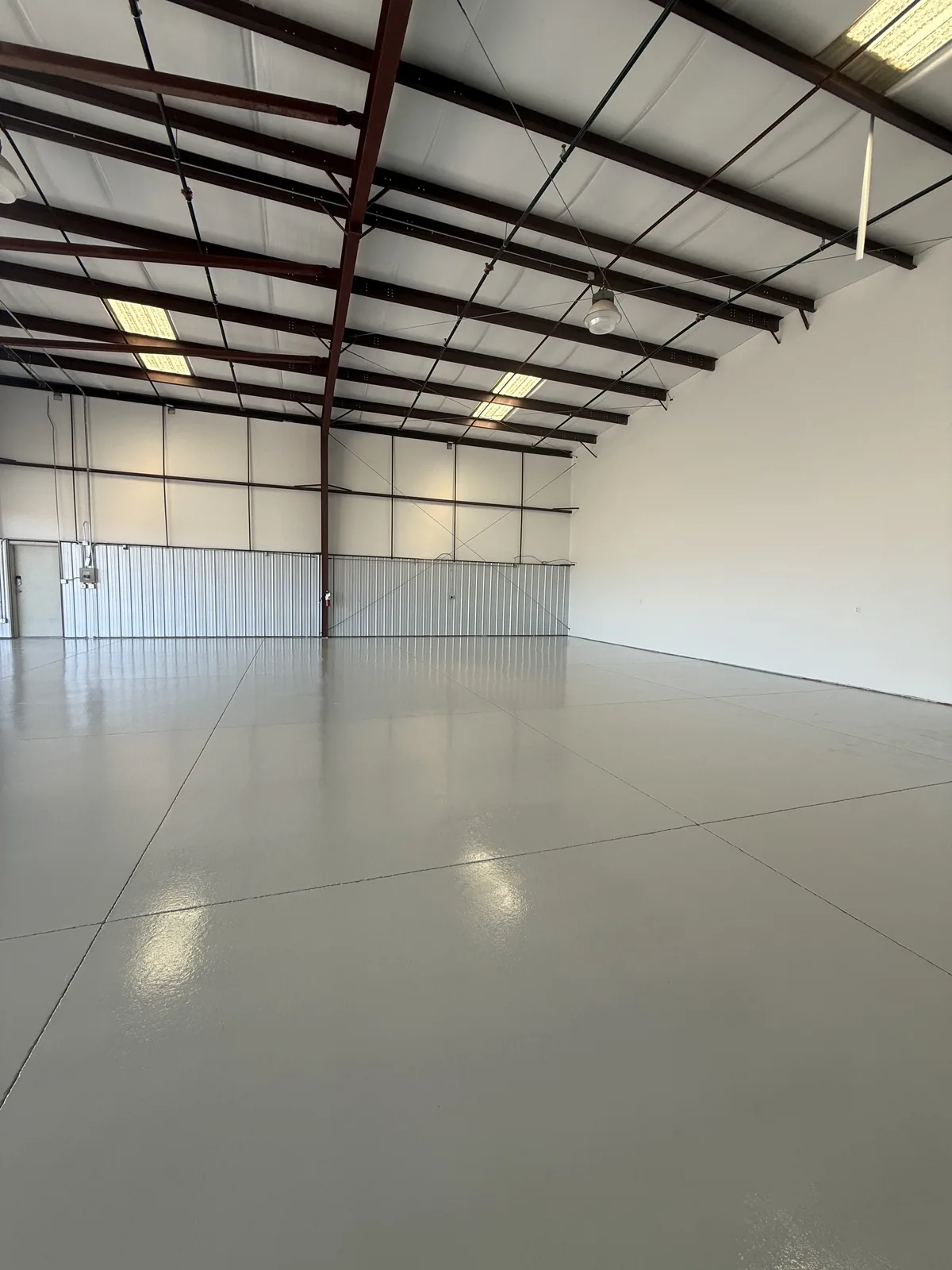
A large empty steel-framed warehouse with a plain pale gray floor coating running wall to wall, the ceiling lights reflected in its surface
A solid color with no flake. It is the plainest finish and it shows every repair in the slab beneath.

What the work is

A solid color floor is a pigmented resin applied over a prepared slab and sealed. It reads as one clean surface, which is why it is the usual choice for a warehouse, a showroom or anywhere a floor is meant to be a background rather than a feature.

Be clear-eyed about what it does not do. Every repaired crack, every patch, every low spot and every bit of settled dust is visible on a solid color floor, and none of it is on a flake floor. If the slab has a history, a solid color will publish it.

It is also the finish where the choice of product matters most visually, because there is no pattern to distract from a color change over time. Ultraviolet stability is a published property of the specific product, printed on its data sheet. Ask which product, and ask to see the sheet.

We will steer you off a solid color onto flake where the slab does not deserve it. That is a smaller job for us and the right answer for you.

What is included

  • The color agreed from a physical sample
  • Pigmented resin over a prepared, tested slab
  • Clear or pigmented top coat as the system requires
  • A plain account, before you commit, of what the finished floor will show

What is not

  • Hiding an unsound slab. A solid color is the wrong finish for that and we will say so
  • Color matching to anything but a physical sample
  • Touch-up to an area after cure that blends invisibly. It will not

The sun question, answered properly

A garage door open through a Washington County summer puts direct sun on the first several feet of floor, every day, for months. Whether a coating holds its color under that is a property of the chemistry, and manufacturers publish it.

Polyaspartic products are described by their makers as ultraviolet-resistant and color-stable; aliphatic polyaspartic products state ultraviolet stability by name on the data sheet. That is checkable, which means its absence is checkable too. So ask which product is going down and ask to read the sheet — of us and of anybody else quoting you.

What to ask anyone quoting this, us included

  • Which product, and what does its data sheet say about ultraviolet exposure?
  • What will the repaired areas look like once the color is on?
  • Is the slab flat enough for a solid color, honestly?

What we can show you in writing

Every line traces to a document we read in full. The number after a sentence points to the research below.

  • Ultraviolet stability is a published property of a specific product, not of a trade name. Sherwin-Williams describes polyaspartic floor coating as part of the urethane family, extremely durable and fast-curing, offering UV-resistant, color-stable protection; its aliphatic polyaspartic products state UV stability by name on the data sheet.1
  • Concrete substrates must be mechanically prepared to remove cement laitance, existing coatings and curing compounds, and to achieve a profile that is clean, dry and free of dirt, grease and oil. Diamond grinders create that profile and remove high spots and coatings; shot blasting is described as the industry standard for surface preparation of concrete.1

Where this comes from

Every line above traces to a document we read in full. The number after a sentence points to the research below; hover it for the section. If you find a line wrong, tell us and we will fix it and say so.

  1. Concrete coatings research, September 2026 Compiled from ICRI Guideline 310.2R-2013 on concrete surface preparation, the ASTM moisture test standards F2170, F1869 and D4263, ACI 302.2R and NRMCA CIP 29 on slabs and vapor retarders, Sika's published surface preparation guide, Sherwin-Williams product literature on polyaspartic chemistry, and the Utah Geological Survey and Utah DEQ material already cited in the environment research. 2 sections cited. Hover a number above for the section.

The rest of garage floors

  • Garage floor coating

    The bay emptied, the slab ground back, and a finish that is bonded to concrete rather than sitting on it.

  • Flake floor

    Vinyl chips broadcast into a wet base coat and locked under a clear top coat. The common finish, and the one in most of the photographs here.

  • Metallic floor

    A pigmented resin worked while wet so the color moves. No two are the same, which is the point and also the risk.

  • Grind and seal

    The concrete itself is the finish. Ground back, then sealed. Nothing is added on top to fail.

The quote is the number. There is no second number.

Call (801) 680-6859

7 a.m. to 5 p.m., weekdays. Emergency calls answered any hour, every day.