
St. George Home Services

Concrete coatings · Garage floors

Grind and seal

The concrete itself is the finish. The slab is ground back and sealed, and nothing is added on top. It is the least material, the least money and the least there is to fail.

One flat fee to find out what is wrong. You are told it on the phone before anyone is dispatched, and it comes off the job if you hire us. Read our Plain Terms

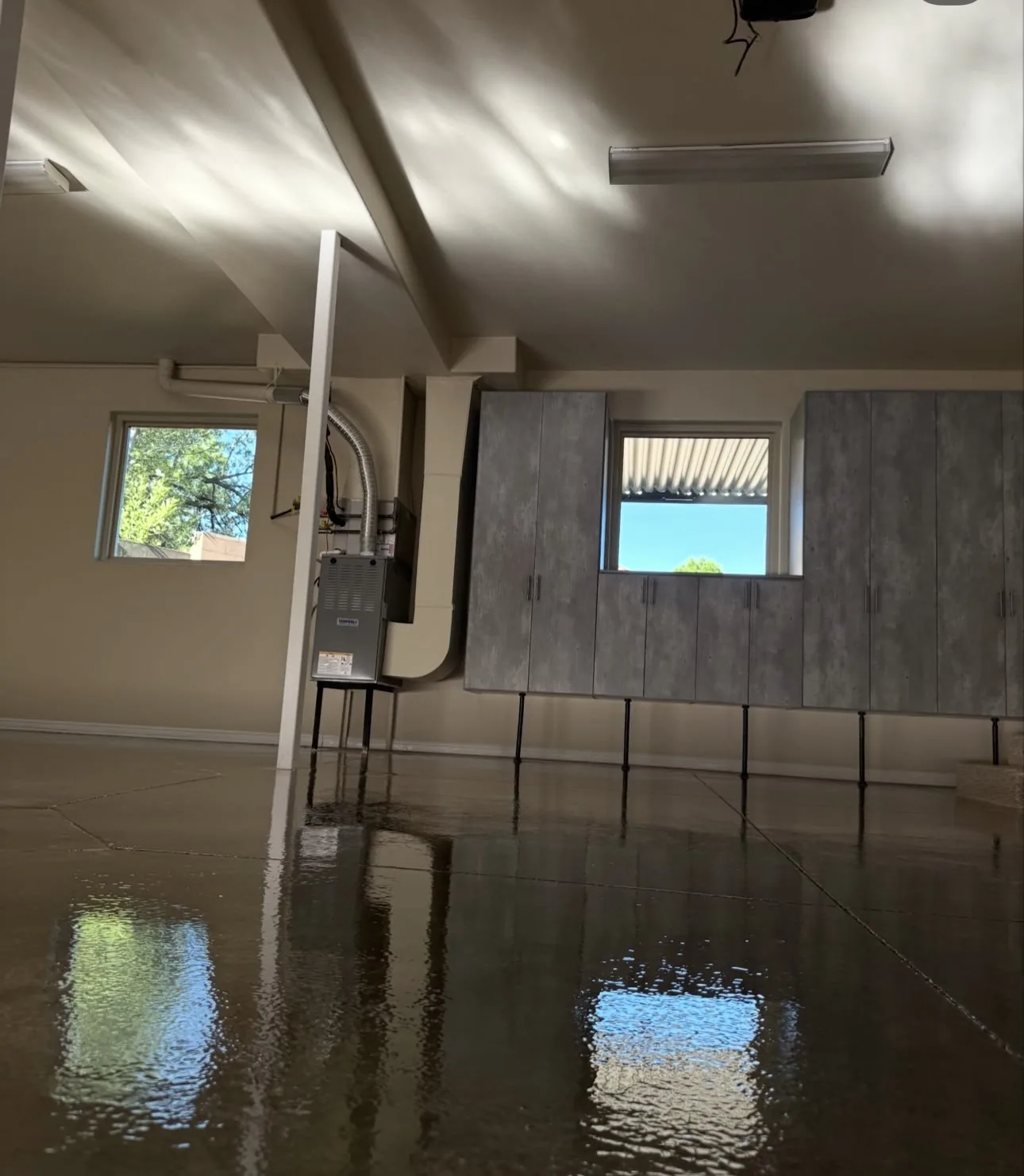
A garage slab still wet after washing, the windows, ceiling and wall cabinets above reflected in the standing water on its surface
Washed down. The mirror is water, not a finish.

What the work is

Grind and seal is what it sounds like. Diamond grinding takes the slab back — lightly, to clean it up, or deeper, to open the aggregate — and a sealer goes over that. The color, the joints and the variation in the concrete stay visible, because they are the finish.

It suits two situations. One is a slab that is genuinely good-looking and sound, where a coating would be covering something worth keeping. The other is a budget: it is the cheapest of these finishes by a distance and it still gives you a floor that cleans.

What it does not do is hide anything. Stains that have soaked into the slab are still in the slab. Grinding removes the top of the concrete, so it takes shallow staining with it, but oil that has travelled down is not coming out and a sealer will make it darker rather than lighter.

It is also the finish that wants re-doing rather than repair. A sealer wears, particularly where tires turn. Re-sealing is a straightforward recurring job, and we would rather you knew that up front than discovered it in year three.

What is included

  • Diamond grinding to the agreed level, edges cut in by hand
  • Dust extraction at the machine
  • A plain account of which existing stains will and will not come out
  • Sealer applied to the ground slab
  • Telling you what re-sealing will involve and roughly when

What is not

  • Removing staining that has penetrated the slab. Grinding takes the surface, not the depth
  • A uniform color. The concrete is the finish and concrete is not uniform
  • Polished concrete, which is a different process with different machinery and a different price

What the ground here does to a slab

Gypsiferous soil and rock is one of the nine adverse construction conditions the Utah Geological Survey mapped across the St. George and Hurricane area, and Washington County publishes it as its own hazard layer. Where sulfate is present in the ground it attacks concrete itself.

That matters more for grind and seal than for any other finish here, because the concrete is what you are keeping. On an exterior slab in a mapped zone, the condition of the concrete is the first question, not the last one. Under the American Concrete Institute exposure classes, a soil sulfate test is what determines the mix a slab needed; sulfate-resistant cement is required at class S2 and above. We are not going to tell you your slab is failing, and we are not going to tell you it is fine. We will tell you what we can see.

What to ask anyone quoting this, us included

  • How deep are you grinding, and what will that expose?
  • Which of these stains are coming out, and which are not?
  • What is the sealer, and how often will it want doing again?

What we can show you in writing

Every line traces to a document we read in full. The number after a sentence points to the research below.

  • Concrete substrates must be mechanically prepared to remove cement laitance, existing coatings and curing compounds, and to achieve a profile that is clean, dry and free of dirt, grease and oil. Diamond grinders create that profile and remove high spots and coatings; shot blasting is described as the industry standard for surface preparation of concrete.1
  • Gypsiferous soil and rock is one of the nine adverse construction conditions mapped in UGS Special Study 127 and published by Washington County as its own hazard layer. Under the ACI exposure classes a soil sulfate test determines the required concrete mix — class S1 at 0.10 to 0.20 per cent water-soluble sulfate in soil, S2 at 0.20 to 2.00 per cent where sulfate-resistant cement is required, S3 above that. St. George culinary water itself reaches 451 ppm sulfate, inside class S1 for water contact.2

Where this comes from

Every line above traces to a document we read in full. The number after a sentence points to the research below; hover it for the section. If you find a line wrong, tell us and we will fix it and say so.

  1. Concrete coatings research, September 2026 Compiled from ICRI Guideline 310.2R-2013 on concrete surface preparation, the ASTM moisture test standards F2170, F1869 and D4263, ACI 302.2R and NRMCA CIP 29 on slabs and vapor retarders, Sika's published surface preparation guide, Sherwin-Williams product literature on polyaspartic chemistry, and the Utah Geological Survey and Utah DEQ material already cited in the environment research. 1 section cited. Hover a number above for the section.
  2. Environment, water and ground research, August 2026 Compiled from the cities' own water quality reports, Utah Geological Survey Special Study 127, the Utah State Hazard Mitigation Plan, Washington County GIS hazard layers, NOAA climate records, EPA radon zones and Census QuickFacts. 1 section cited. Hover a number above for the section.

The rest of garage floors

  • Garage floor coating

    The bay emptied, the slab ground back, and a finish that is bonded to concrete rather than sitting on it.

  • Flake floor

    Vinyl chips broadcast into a wet base coat and locked under a clear top coat. The common finish, and the one in most of the photographs here.

  • Solid color floor

    One color, no chips. The plainest finish, and the one that shows every repair in the slab beneath it.

  • Metallic floor

    A pigmented resin worked while wet so the color moves. No two are the same, which is the point and also the risk.

The quote is the number. There is no second number.

Call (801) 680-6859

7 a.m. to 5 p.m., weekdays. Emergency calls answered any hour, every day.