
Permanent lighting is booking now for the holidays.

See permanent lighting
St. George Home Services

Heating and air · When it stops working

Furnace repair

No heat, short cycling, or a unit that runs and never satisfies the thermostat.

One flat fee to find out what is wrong. You are told it on the phone before anyone is dispatched, and it comes off the job if you hire us. Read our Plain Terms

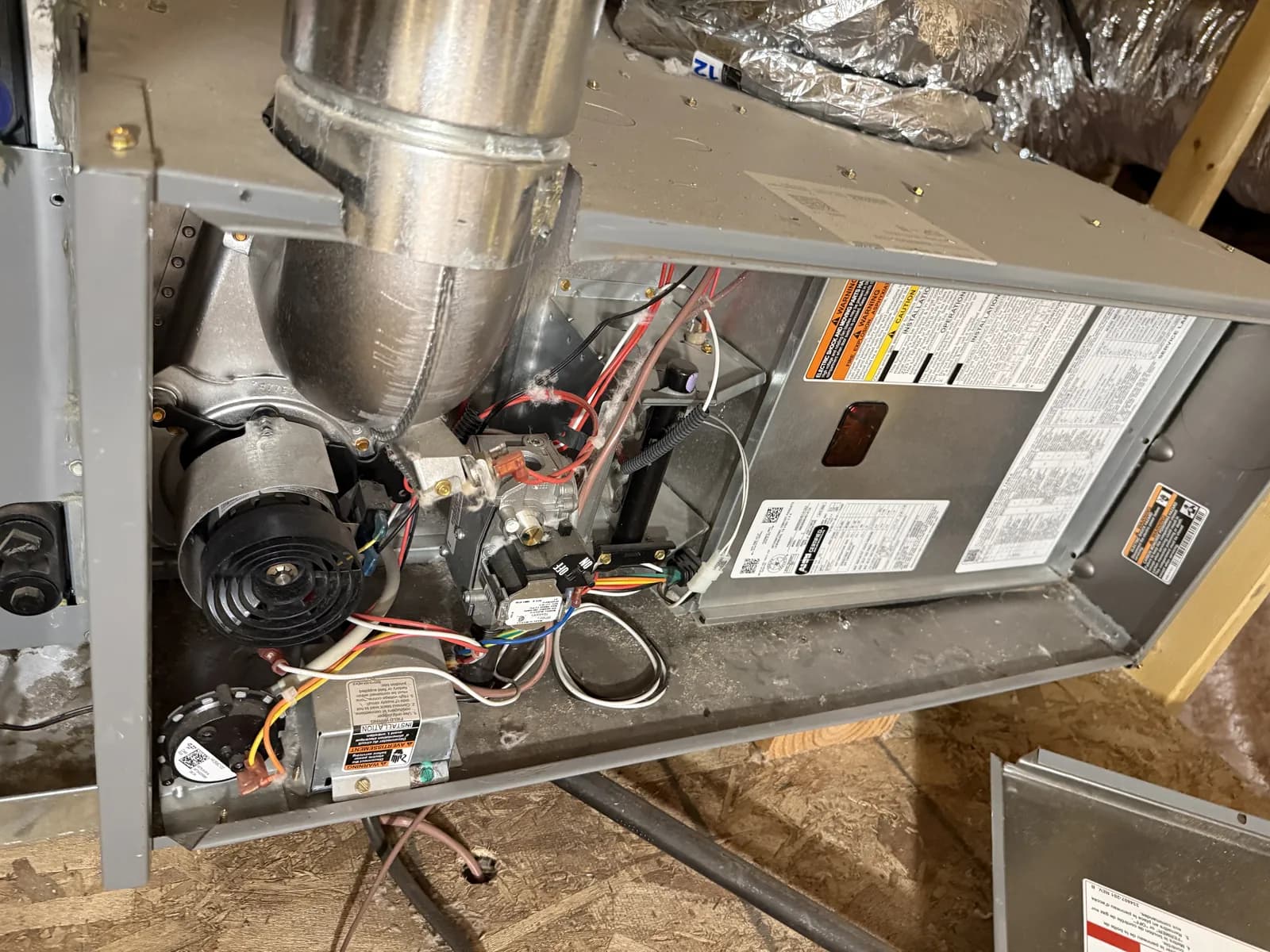
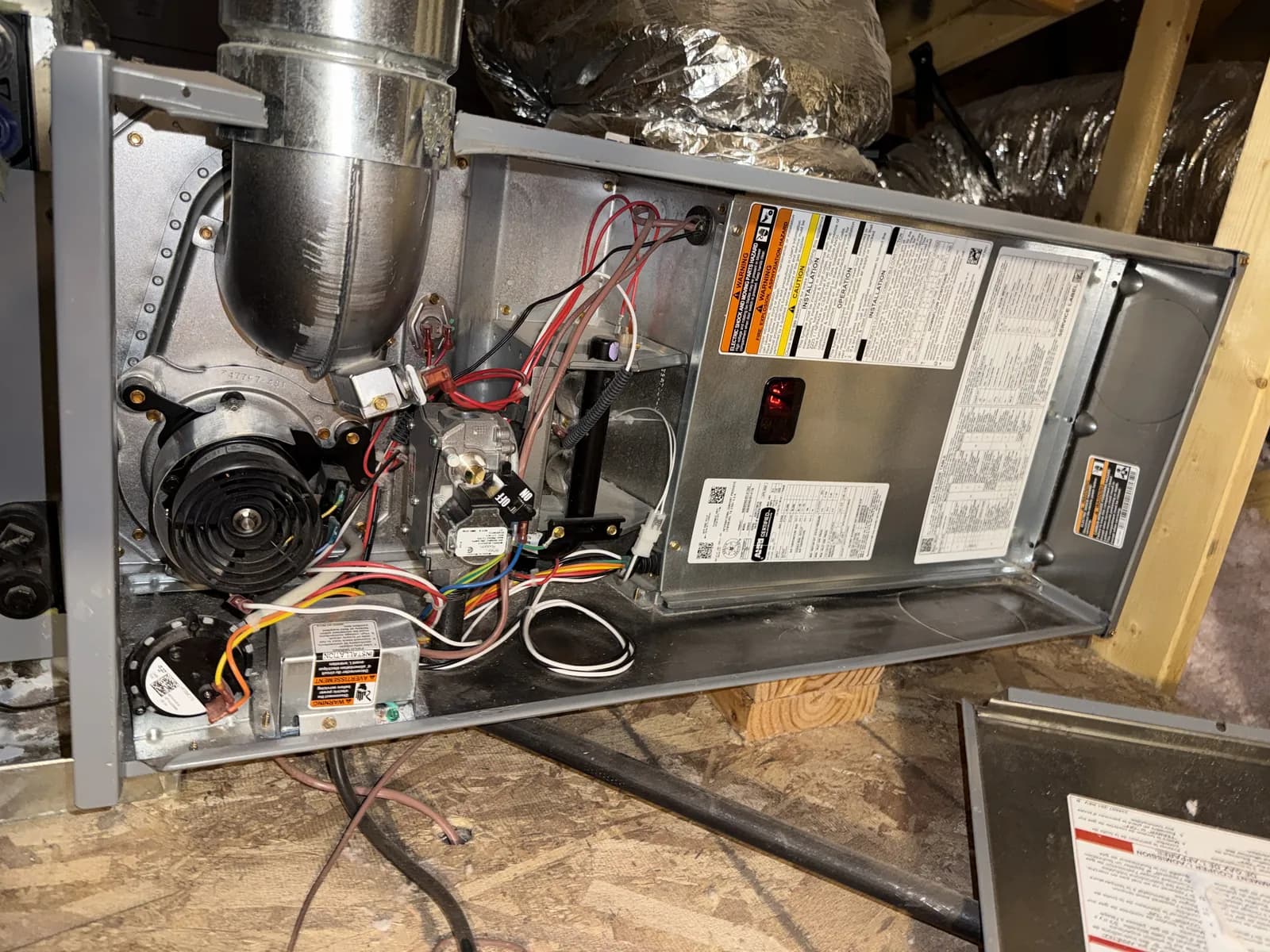
A gas furnace lying in an attic with its access panel off, showing the inducer motor, gas valve, control board and wiring, with dust across the cabinet and insulated ducts behind
An attic furnace with the panel off, before the service. St. George, Utah.

What the work is

Most winter calls here are an igniter, a flame sensor, a pressure switch reading a blocked flue or condensate line, or a limit switch tripping because airflow is restricted. The last one is worth saying plainly: a furnace that keeps shutting off is often not a broken furnace, it is a choked filter or a collapsed duct, and replacing the part does not fix it.

Anything touching combustion gets checked before we leave, whatever we came for.

The parts that fail are a short list and most of them are inexpensive: a hot surface igniter, a flame sensor that has gone dirty enough to stop proving flame, a pressure switch that is doing its job because a flue or a condensate line is blocked, or a limit switch tripping on restricted airflow.

The last two are the ones worth understanding, because the part is not the fault. A pressure switch that will not close is usually telling you something is obstructed. A limit switch that keeps tripping is telling you the furnace cannot move enough air through itself, and the cause is nearly always a filter, a closed-off return, or ductwork that has come apart. Replacing the switch in either case buys you a few weeks.

So the first thing we do on a no-heat call is not order a part. It is find out what the part was reacting to.

What is included

  • The failed part named, with the reading behind it
  • A combustion and venting check on any gas appliance we open
  • The airflow restriction found, if that is what tripped the limit
  • The cause behind the failed part, not just the part
  • A carbon monoxide check in the space around the appliance

What is not

  • Condemning a heat exchanger without showing you what we found
  • Work on the gas line beyond the appliance connection unless it is quoted separately
  • Replacing a switch that was doing its job, without finding what tripped it

What to ask anyone quoting this, us included

  • Did you check airflow before replacing the part?
  • Can you show me what you found?
  • What did the combustion test read?
  • Was the part faulty, or was it responding to something else?
  • Did you check the flue and the condensate drain?
What we can show you in writing

Every line traces to a document we read in full. The number after a sentence points to the research below.

  • The furnace side is gated twice in Utah statute. Subsection 58-55-305(1)(h)(ii) carves both HVAC work and gas appliance and combustion system work out of the small-job licensing exemption, and neither carve-out has a dollar threshold on it.1
  • Utah requires the qualifier behind an H-100 HVAC license to be a Certified Natural Gas Technician, with an RMGA certificate or the equivalent, on top of the written trade exam. Ask who holds it.1
  • The normal daily low in St. George is 27.9°F in December and 28.4°F in January. An average winter night here is below freezing, in the one Utah county the Department of Energy calls Hot-Dry.1

Where this comes from

Every line above traces to a document we read in full. The number after a sentence points to the research below; hover it for the section. If you find a line wrong, tell us and we will fix it and say so.

  1. Heating and air research, September 2026 Compiled from the Code of Federal Regulations at 10 CFR 430 and the Federal Register, EPA rules on refrigerant transition, the Utah Code and Utah DOPL's licensing records, ACCA's load calculation standard, ASHRAE and the AHRI directory, Pacific Northwest and Lawrence Berkeley National Laboratory publications, NOAA climate normals, ENERGY STAR, and the published data of Trane, Lennox and Daikin. 3 sections cited. Hover a number above for the section.

The rest of when it stops working

The quote is the number. There is no second number.

Call (435) 850-0053

7 a.m. to 5 p.m., weekdays. Emergency calls answered any hour, every day.