Permanent lighting is booking now for the holidays.

See permanent lighting
St. George Home Services

Heating and air · Keeping it running

AC and furnace tune-up

Measured, not eyeballed. You get the readings whether or not we find anything wrong.

One flat fee to find out what is wrong. You are told it on the phone before anyone is dispatched, and it comes off the job if you hire us. Read our Plain Terms

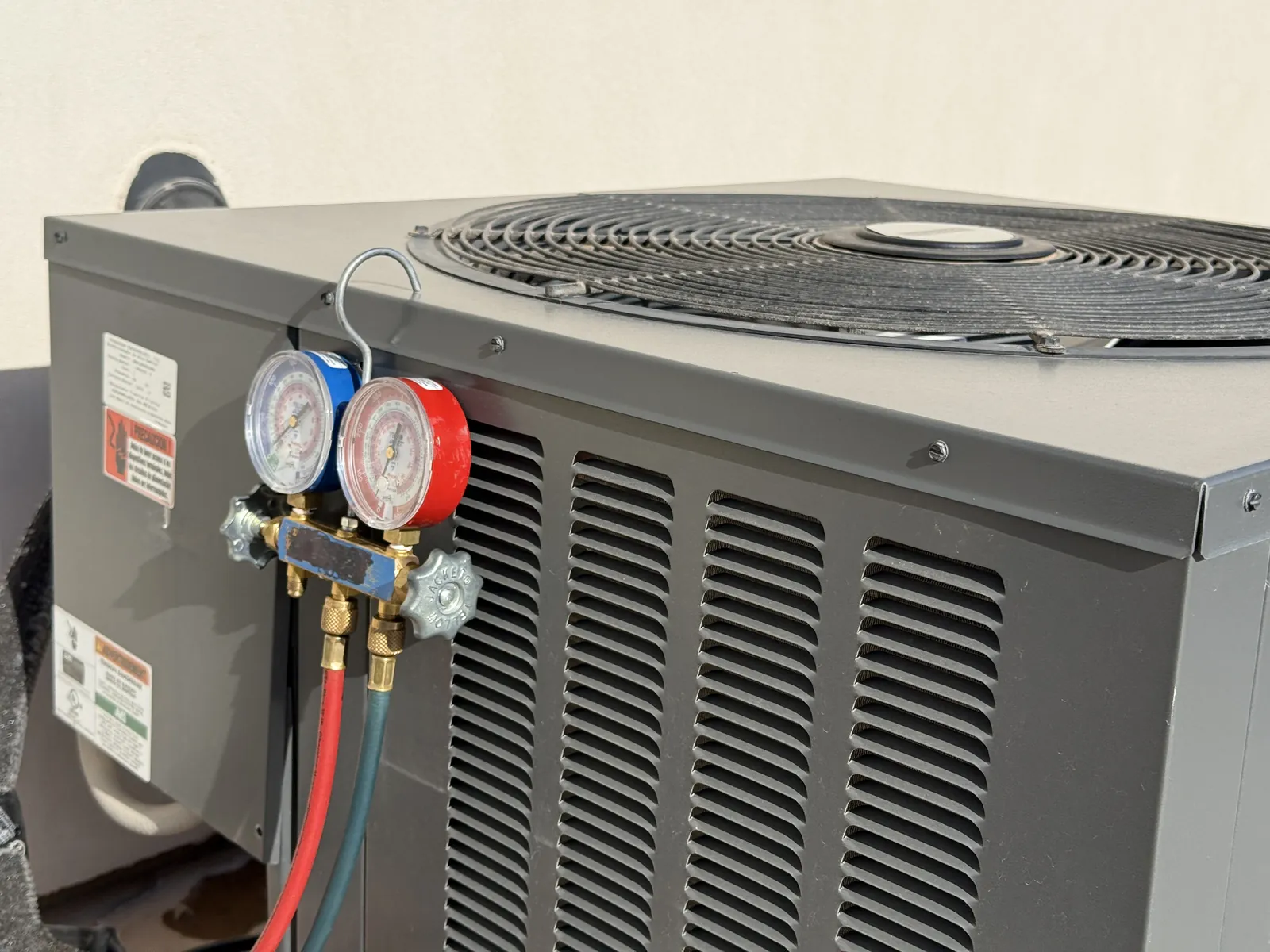
A manifold gauge set hooked to the service ports of an outdoor air conditioning condenser, the red and blue hoses running down to the unit and the fan grille above
Gauges on the service ports, reading pressures before anything is quoted. St. George, Utah.

What the work is

A tune-up that produces no numbers is a wash and a sticker. Ours produces a sheet: temperature split across the coil, static pressure, capacitor values against their rating, amp draw against the nameplate, and refrigerant pressures with the ambient they were taken at.

That sheet is the point. Next year's readings against this year's are how you see a capacitor drifting or a coil loading up before either one strands you in July, and it is how you check us.

The full list of what gets recorded: supply and return temperatures and the split between them, total external static pressure, capacitor microfarads against the rating stamped on each one, compressor and fan amp draw against the nameplate, refrigerant pressures with the outdoor ambient noted beside them, and the condensate drain cleared and confirmed running.

Twice a year is the industry line and it is not always the honest one. If you have a cooling-dominant system that barely runs in winter, once a year before the season is the sensible interval and we will say so rather than sell you two.

What is included

  • The coil cleaned and the condensate line cleared
  • Capacitors measured against their rated value, not just looked at
  • Temperature split, static pressure and amp draw recorded
  • The readings written down and left with you
  • The condensate drain cleared and confirmed flowing
  • A recommended interval based on your system, not a standard answer

What is not

  • Parts replaced because they are old, when they measure within tolerance
  • A refrigerant top-up as routine maintenance. If it is low, it is leaking, and that is a different job

What to ask anyone quoting this, us included

  • What readings will I get, and do I keep them?
  • Did you measure the capacitors or look at them?
  • What was the temperature split?
  • What interval does my system actually need?
  • Will you leave me the readings?

What we can show you in writing

Every line traces to a document we read in full. The number after a sentence points to the research below.

  • The measurable thing is static pressure, not the number on the filter box. Pacific Northwest National Laboratory publishes 0.4 to 0.5 inches of water column as the ceiling for a residential system's total pressure drop. A measured reading can be set beside it.1
  • Lawrence Berkeley National Laboratory found filter loading rates varied more from house to house than by MERV rating, and were low in many of the homes measured. How fast your filter loads is a fact about your house, not about the filter.1
  • Nothing in the federal refrigerant rule stops anyone from servicing an R-410A system, and nothing in it requires you to replace one that works. A tune-up is not a sales call about your refrigerant.1

Where this comes from

Every line above traces to a document we read in full. The number after a sentence points to the research below; hover it for the section. If you find a line wrong, tell us and we will fix it and say so.

  1. Heating and air research, September 2026 Compiled from the Code of Federal Regulations at 10 CFR 430 and the Federal Register, EPA rules on refrigerant transition, the Utah Code and Utah DOPL's licensing records, ACCA's load calculation standard, ASHRAE and the AHRI directory, Pacific Northwest and Lawrence Berkeley National Laboratory publications, NOAA climate normals, ENERGY STAR, and the published data of Trane, Lennox and Daikin. 2 sections cited. Hover a number above for the section.

The rest of keeping it running

The quote is the number. There is no second number.

Call (435) 850-0053

7 a.m. to 5 p.m., weekdays. Emergency calls answered any hour, every day.